
Neil McCoy-Ward covers many issues, primarily financial. Here he’s discussing critical resource shortages around the world as a result of the war, and the rationing systems being put in place. On a personal level, he’s been experiencing a ‘shoot the messenger’ effect, due to people’s fear of another lockdown, given how traumatic people found the covid era. Unfortunately another lockdown is very much on the cards, and it obviously doesn’t help to blame those who warned of this in advance. These are the global supply shares at risk:
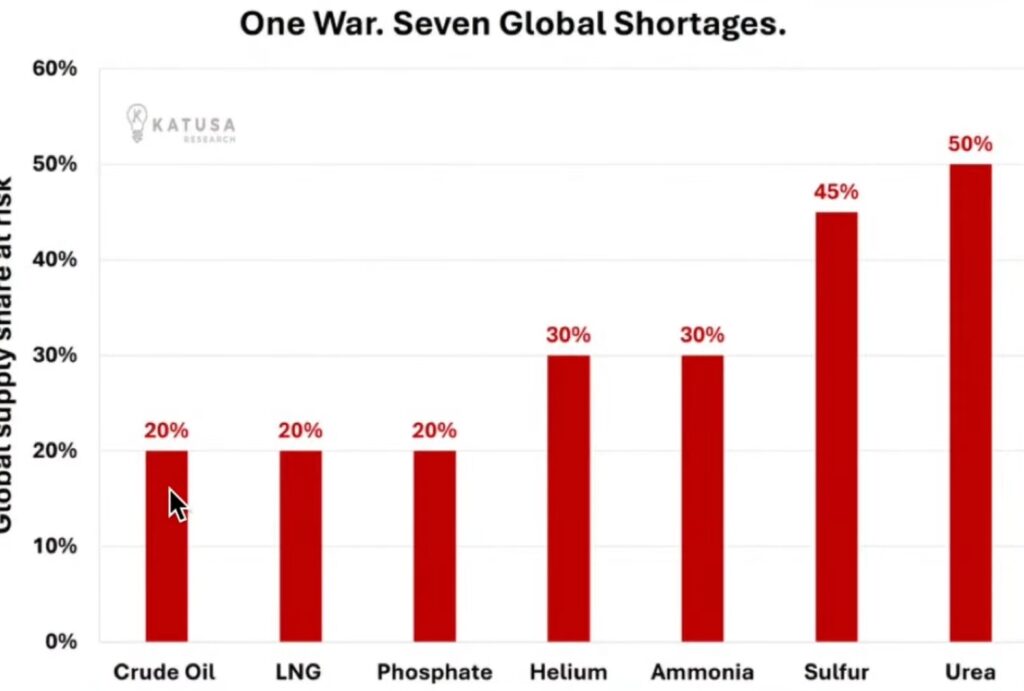
The missing resources are all critical to various industries, and cannot be replaced. The global economy has been engineered for economic efficiency, meaning a global just-in-time system with highly integrated supply chains and very few stocks or reserves. This was the product of a high trust world (relatively speaking) at the top of a major financial cycle. That cycle is now ending, and trust is collapsing with economic contraction. All those interconnected supply chains are vulnerable, and many will fail. In the Great Depression of the 1930s, trade fell by 66% in two years, with trade wars, protectionism, neo-mercantilism, and gunboat diplomacy, followed by kinetic war. We’re looking at a similar breakdown today, but today we’re far more dependent on trade than we were then, and our newly brittle networks are vastly more complex. When a system such as ours goes into contraction, our economic efficiency turns into the straightest path to hell.
Countries are going to need to restore self-sufficiency, but how many citizens in many countries even know what their local reality would be in the absence of imports and exports? It’s going to be a steep learning curve, and it needs to be addressed as quickly as possible, beginning with working out where the essentials are going to come from. Anything non-essential can wait. Unfortunstely, the countries which benefitted disproportionately from globalisation can expect to suffer disproportionately from its demise, and this includes my own country of New Zealand, where we lie a long way from anywhere at the far end of supply chains.
“The closure of Hormuz has taken 34% of globally-traded crude oil, 12% of refined petroleum, 20% of LNG offline. It has taken 30% of urea and 25% of ammonia offline, putting the northern planting season at risk in the largest shock to food production in generations. Some 20% of aluminum production if offline too. In the chips supply chain, in addition to the LNG, 35% of helium, 60% of bromine, and 44% of sulphur are now offline.
Unless the war ends soon and Hormuz is reopened, this will be the single greatest stagflationary shock in the history of the modern world economy. And the costs are cumulative. The longer the war lasts, the greater the stagflationary shock and the more central banks must respond by monetary tightening.”
~ Policy Tensor