

Palantir is the face of the developing technical industrial complex (TIC), which is currently challenging both the financial industrial complex (FIC) and the military industrial complex (MIC) for global domination. The technological control they’ve already achieved through the theft and integration of vast amounts of data on billions of individuals is staggering. Now they plan to use that power to gain monopolistic control over the entire population, as Founder Peter Thiel has long sought to do since giving up on the ideas of democracy and freedom years ago.
This power has already been used to deal death on a large scale, using Gaza as the testing ground. Specific individuals were targeted for even the most tangential connections to Hamas. They were monitored until returning home by a programme named “Where’s Daddy”, whereupon their entire apartment complex would be destroyed by a missile strike, killing potentially hundreds of people along with the intended target. It’s patently obvious that human life has no value to those who treat wars as a video game. Palantir has also been used to target undocumented immigrants in the US, allowing them to be seized and used as profit centres for the private prison system. Most of these people have lived their lives peacefully and paid their taxes, despite never being able to claim any benefits, but were targeted, often brutally, in any case. Palantir also bought the NHS health data in the UK and is now in control of that system, very much not to the benefit of the citizenry. It will be used to detect ‘pre-crime’, in other words identifying dissidents, categorizing them as terorrists, and incarcerating them for profit and forced labour. This is the most ruthlessly fascistic system ever developed, and it intends to take control of the entire world. Humans are to be used as non-player characters in a huge video game, where enormous casualties are a feature, not a bug.
Fortunately, the scope of what they ultimately plan will lie outside the range of what future reality can hope to deliver. The energy required to increase, or even maintain, the necessary complexity is very unlikely to exist in a future where so much energy infrastructure all around the world is being deliberately destroyed. The destruction is part of a plan to reduce the global population to a more ‘managable’ size, and to do so quickly, before countries and individuals have a chance to prepare for the engineered crisis. This is exactly what psychopaths could be expected to do in the face of approaching non-negotiable resource limits in energy, fresh water, fertile soil, expansion space, financial engineering/’creative accounting’ fraud etc.
These people are manifestly delusional. They believe that the Epstein class is a different species from the rest of us who are classed as some kind of undifferentiated biomass. They believe they can create their own reality, and through their own ‘brilliance’ they expect to find a way to live forever. Naturally this means they would need to create ‘lebensraum’ (living space) for their own immortal descendents, and to save resources for these hypothetical immortals, the ‘useles eaters’ must be removed. Great wealth leads to great hubris, and major departures from reality, but reality bats last. This attempt at extreme centralisation will ultimately fare no better than previous less ambitious attempts throughout history, but it can be expected to make an enormous mess of the world in the meantime. Communities must urgently come together to support each other through the crisis. We need to outlast their ability to harm us.
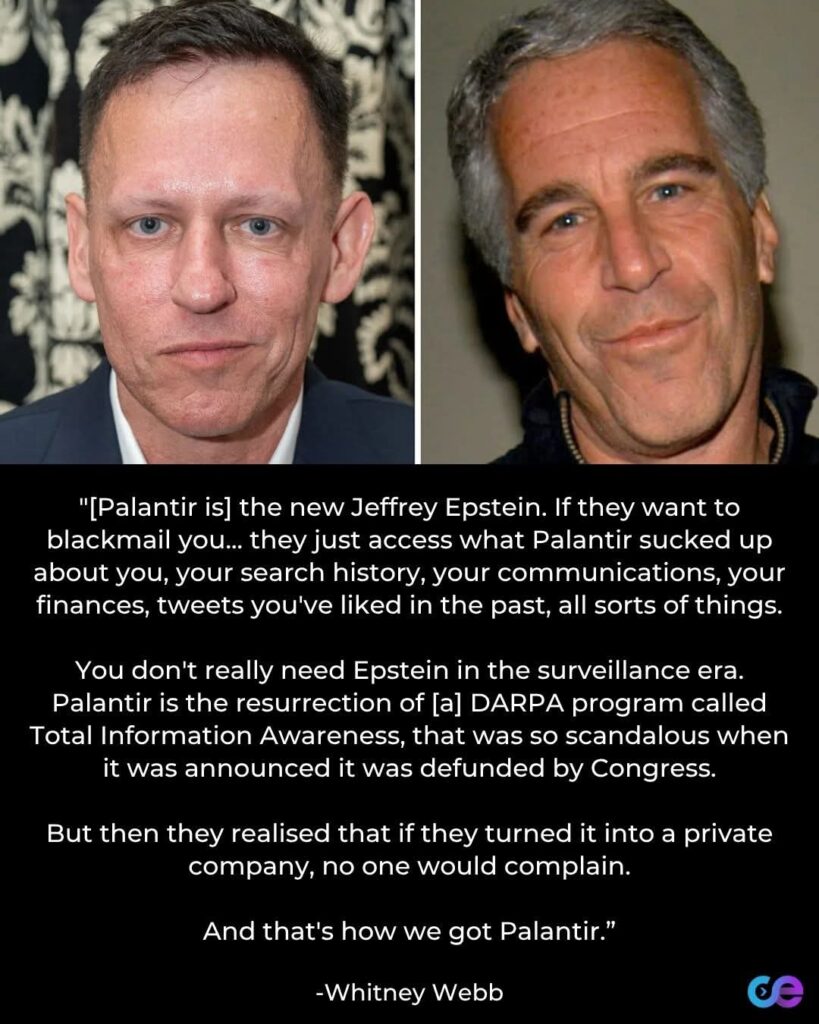
This is the manifesto that Palantir just published, followed by insightful commentary from many different writers:
- Silicon Valley owes a moral debt to the country that made its rise possible. The engineering elite of Silicon Valley has an affirmative obligation to participate in the defense of the nation.
- We must rebel against the tyranny of the apps. Is the iPhone our greatest creative if not crowning achievement as a civilization? The object has changed our lives, but it may also now be limiting and constraining our sense of the possible.
- Free email is not enough. The decadence of a culture or civilization, and indeed its ruling class, will be forgiven only if that culture is capable of delivering economic growth and security for the public.
- The limits of soft power, of soaring rhetoric alone, have been exposed. The ability of free and democratic societies to prevail requires something more than moral appeal. It requires hard power, and hard power in this century will be built on software.
- The question is not whether A.I. weapons will be built; it is who will build them and for what purpose. Our adversaries will not pause to indulge in theatrical debates about the merits of developing technologies with critical military and national security applications. They will proceed.
- National service should be a universal duty. We should, as a society, seriously consider moving away from an all-volunteer force and only fight the next war if everyone shares in the risk and the cost.
- If a U.S. Marine asks for a better rifle, we should build it; and the same goes for software. We should as a country be capable of continuing a debate about the appropriateness of military action abroad while remaining unflinching in our commitment to those we have asked to step into harm’s way.
- Public servants need not be our priests. Any business that compensated its employees in the way that the federal government compensates public servants would struggle to survive.
- We should show far more grace towards those who have subjected themselves to public life. The eradication of any space for forgiveness—a jettisoning of any tolerance for the complexities and contradictions of the human psyche—may leave us with a cast of characters at the helm we will grow to regret.
- The psychologization of modern politics is leading us astray. Those who look to the political arena to nourish their soul and sense of self, who rely too heavily on their internal life finding expression in people they may never meet, will be left disappointed.
- Our society has grown too eager to hasten, and is often gleeful at, the demise of its enemies. The vanquishing of an opponent is a moment to pause, not rejoice.
- The atomic age is ending. One age of deterrence, the atomic age, is ending, and a new era of deterrence built on A.I. is set to begin.
- No other country in the history of the world has advanced progressive values more than this one. The United States is far from perfect. But it is easy to forget how much more opportunity exists in this country for those who are not hereditary elites than in any other nation on the planet.
- American power has made possible an extraordinarily long peace. Too many have forgotten or perhaps take for granted that nearly a century of some version of peace has prevailed in the world without a great power military conflict. At least three generations — billions of people and their children and now grandchildren — have never known a world war.
- The postwar neutering of Germany and Japan must be undone. The defanging of Germany was an overcorrection for which Europe is now paying a heavy price. A similar and highly theatrical commitment to Japanese pacifism will, if maintained, also threaten to shift the balance of power in Asia.
- We should applaud those who attempt to build where the market has failed to act. The culture almost snickers at Musk’s interest in grand narrative, as if billionaires ought to simply stay in their lane of enriching themselves . . . . Any curiosity or genuine interest in the value of what he has created is essentially dismissed, or perhaps lurks from beneath a thinly veiled scorn.
- Silicon Valley must play a role in addressing violent crime. Many politicians across the United States have essentially shrugged when it comes to violent crime, abandoning any serious efforts to address the problem or take on any risk with their constituencies or donors in coming up with solutions and experiments in what should be a desperate bid to save lives.
- The ruthless exposure of the private lives of public figures drives far too much talent away from government service. The public arena—and the shallow and petty assaults against those who dare to do something other than enrich themselves—has become so unforgiving that the republic is left with a significant roster of ineffectual, empty vessels whose ambition one would forgive if there were any genuine belief structure lurking within.
- The caution in public life that we unwittingly encourage is corrosive. Those who say nothing wrong often say nothing much at all.
- The pervasive intolerance of religious belief in certain circles must be resisted. The elite’s intolerance of religious belief is perhaps one of the most telling signs that its political project constitutes a less open intellectual movement than many within it would claim.
- Some cultures have produced vital advances; others remain dysfunctional and regressive. All cultures are now equal. Criticism and value judgments are forbidden. Yet this new dogma glosses over the fact that certain cultures and indeed subcultures . . . have produced wonders. Others have proven middling, and worse, regressive and harmful.
- We must resist the shallow temptation of a vacant and hollow pluralism. We, in America and more broadly the West, have for the past half century resisted defining national cultures in the name of inclusivity. But inclusion into what?
Excerpts from the #1 New York Times Bestseller The Technological Republic: Hard Power, Soft Belief, and the Future of the West, by Alexander C. Karp & Nicholas W. Zamiska



The following is by Michelle Blair from Collective Evolution on Facebook. No link from facebook is postable unfortunately.
“Palantir recently posted a 22 point manifesto to its social media feed stating “Because we get asked a lot.”
This document deserves to be read carefully as the company is deeply embedded into the US government at the moment, and is making it’s way to other governments. It is one of the most concerning companies on Earth due to what it’s doing.
Let’s look at a couple of points before breaking this down further, I included some of Yanis Varoufakis’ takes on the points as they are spot on:
- Silicon Valley owes a moral debt to the country that made its rise possible. The engineering elite of Silicon Valley has an affirmative obligation to participate in the defense of the nation.
Yanis: Silicon Valley owes an immeasurable debt to the ruling class who bailed out the criminal bankers that wrecked the livelihood of the majority of Americans. The engineering elite of Silicon Valley will defend that ruling class to the death (literally!), in the name of the majority of Americans whom they treat with contempt – i.e., like cattle that have lost their market value.
- Free email is not enough. The decadence of a culture or civilization, and indeed its ruling class, will be forgiven only if that culture is capable of delivering economic growth and security for the public.
Yanis: Palantir shall give nothing away for free. It cares uniquely over its own growth which it pursues by sowing fear so that it can sell a fake sense of security.
- The limits of soft power, of soaring rhetoric alone, have been exposed. The ability of free and democratic societies to prevail requires something more than moral appeal. It requires hard power, and hard power in this century will be built on software.
Yanis: Glory to brute force! Ethics is for suckers. The West needs more of Palantir’s murderous software.
- The question is not whether A.I. weapons will be built; it is who will build them and for what purpose. Our adversaries will not pause to indulge in theatrical debates about the merits of developing technologies with critical military and national security applications. They will proceed.
Yanis: AI-powered killer robots are coming. The task is to profit magnificently by building killer robots first and ask questions later. To be able to do so, Palantir will do whatever it takes to avoid at all cost any international treaties that limit AI-driven killer robots.
It goes on. But I want to talk a bit more about Palantir first.
Palantir was founded in 2003 by Peter Thiel, Alex Karp, and three others. Its two primary platforms, Gotham and Foundry, are not simply software products. They are the connective tissue of the modern American surveillance state.
ICE runs on it. The IRS now runs on it. The Pentagon runs on it. The NYPD and LAPD run on it. The Israel Defense Forces run on it while conducting operations in Gaza.
The company is named after the palantiri, the seeing stones in Tolkien’s Lord of the Rings, objects that allow their holders to watch everything, everywhere, all at once.
Interestingly, in the books, every single palantir that survives into the later ages gets corrupted by Sauron. The stones drive their users toward madness and ruin.
The CIA’s venture capital arm, In-Q-Tel, was the only investor willing to fund Palantir in the early days when Silicon Valley passed. Federal contracts grew from 4.4 million dollars in 2009 to 970 million dollars in 2025 under the current administration. The stock surged 200 percent in a single year. CEO Alex Karp was the highest paid executive in America in 2024, with 6.8 billion dollars in reported compensation.
This is not a technology company in any conventional sense. It is a nervous system being grafted onto a government, one that will be very hard to remove later on.
Peter Thiel, Palantir’s chairman and largest shareholder, wrote an essay in 2009 for the Cato Institute. In it he stated plainly that he had come to believe freedom and democracy were no longer compatible with each other.
The man who chairs the company now embedded inside ICE, the IRS, and the Pentagon has publicly wished, in writing, that the Constitution were weaker so that a sufficiently ambitious person could take hold of the country’s direction.
He is not hiding this. He wrote it down and published it.
Thiel is also the primary financial patron of JD Vance, the current Vice President of the United States. He invested roughly 15 million dollars into Vance’s 2022 Senate primary campaign.
Curtis Yarvin is a blogger and self-described neoreactionary thinker. His program, translated out of the elaborate prose he wraps it in, is straightforward. Abolish democracy. Install a CEO-king, run the country like a corporation, let the people who are actually capable of running things get on with it without the friction of public accountability.
At CE, we’d call this a way of running company or country that puts money making and technology first, not human well being. this type of system would likely be void of the sacred, void of deep meaning as it seeks to make things very machinistic.
Peter Thiel invested in Yarvin’s company Tlon in 2013 through his Founders Fund. In private messages that later became public, Yarvin described himself as coaching Thiel and said Thiel was “fully enlightened, just plays it very carefully.”
We have written before about how the ideas that shape our world rarely arrive through official channels. They arrive through the people who fund the thinkers, who fund the politicians, who fund the platforms. The ideology is upstream of the policy. Always.
Yarvinis the ideological permission structure. The intellectual framework that makes what Palantir is building feel not just acceptable but necessary to the people building it. You do not need everyone to believe the idea. You need the people with the resources and the access to believe it.
The Epstein Connection
First, let me mention Point 18 of the manifesto Palantir published: “The ruthless exposure of the private lives of public figures drives far too much talent away from government service.” And now the Epstein connections they wouldn’t want you to know about…In November 2025, the House Oversight Committee released the Epstein files. The DOJ followed with additional releases in February 2026.
What those documents show is that Peter Thiel corresponded with Jeffrey Epstein from roughly 2014 through early 2019. This continued for eleven years after Epstein’s 2008 conviction as a registered sex offender, and right up until months before Epstein’s 2019 arrest on federal sex trafficking charges.
Epstein referred to Thiel as his “great friend” in private messages to associates.
Epstein invested 40 million dollars in two funds managed through Thiel’s Valar Ventures in 2015 and 2016. That investment has since grown to roughly 170 million dollars. Former Israeli Prime Minister Ehud Barak has described Epstein and Thiel as co-owners of the Valar fund. Thiel’s representatives dispute the word co-owner while confirming Epstein was a limited partner.
Epstein, in recorded conversations, floated Palantir as a company Barak should seek a role at through the Thiel connection.
I want to be direct about why this matters, because it is easy to let it get lost in the noise of everything else.
This is the capital structure of the company now building ICE’s deportation platform. The chairman of a 400 billion dollar surveillance company took transformative money from a convicted sex offender a decade after that conviction, used that person as a relationship broker with former heads of state, and is now embedded at the center of the American government.
The Government Is Now Running On Palantir
ICE signed a 30 million dollar contract with Palantir in April 2025 to build what they are calling ImmigrationOS, an AI platform designed to track self-deportations and feed the mass deportation operation being run by Stephen Miller. Miller reportedly holds a personal financial stake in Palantir.Palantir employees have been embedded inside the IRS, helping build what Senator Ron Wyden described in a June 2025 letter as a single searchable database of every American’s tax records. Multiple members of DOGE, the entity that selected Palantir for this work, are former Palantir employees.
Trump hired Gregory Barbaccia, Palantir’s former head of intelligence and investigations, as the federal Chief Information Officer.
The Pentagon handed Palantir roughly 10 billion dollars in Army contracts in August 2025. The Navy signed a nearly 1 billion dollar software contract in November 2024.
Palantir’s lobbying spend went from 2.4 million dollars in 2020 to 6.1 million dollars in 2025. They hired Miller Strategies, the lobbying firm most closely associated with the Trump administration.
Again, CE has spoken about the Moloch dynamic, the way systems create incentive structures that reward certain behaviors regardless of the ethics of the people inside them. What we are looking at here is something related but distinct. This is not just a system producing bad incentives; it’s a specific group of people, with a specific ideology, deliberately constructing the infrastructure that will make their vision of the world structurally permanent.
Going back to the 22 points…
Point 6 calls for national service as a universal duty. A draft, in plain language. Working class kids in the field. Palantir employees running the dashboards from Palo Alto.
Point 12 argues that the atomic age is ending and a new era of deterrence built on AI is beginning. Nuclear weapons were governed by international treaties. AI weapons, under this vision, are governed by Palantir’s contracts.
Point 21 states that some cultures have produced vital advances while others remain dysfunctional and regressive.
This is civilizational ranking. Published by a company that has access to every American’s tax records, immigration status, license plate movements, and targeting data. The question of which cultures are deemed regressive, and whose software will act on that determination, is not abstract.
Point 22 calls for resistance to what it describes as “a vacant and hollow pluralism.”
As Yanis translated: According to Palantir, Blacks, Muslims, most Asians, and of course women, are inferior untermensch. Blokes in America, and more broadly the West, have for the past half century resisted putting these subhumans in their places in the name of inclusivity. It was a mistake. Such subhumans must never be allowed in, except as servants or sex service providers – at least until we can improve our robots, in which case we won’t need them at all.
Once again, what we bring up all the time around Breaking The Illusion is important here. The story we have been told about how power works in democratic societies is not an accurate description of how power actually works. It is a story designed to produce a particular kind of citizen. One who believes the system is fundamentally oriented toward their wellbeing, who trusts the institutions, and who therefore does not look too carefully at what is actually being built.
Palantir is what you find when you look carefully, and systems like this have always been there.
The people building this are not operating in a vacuum. They are operating inside a worldview. A specific, coherent, deeply held set of beliefs about what human beings are, what society is for, and what the future should look like.
They feel that most people are not capable of governing themselves. That the people who are capable of running things should be freed from the friction of public accountability to get on with it. That competition is the fundamental law of human existence and that the winners of that competition have earned the right to shape the world. As you might sense, this is not a new worldview, it is a very old one dressed in new language.
And the reason it keeps returning, in different forms across different eras, is that it speaks to something real about how power concentrates when systems are not designed to prevent it. When incentives reward the accumulation of advantage. When the people with the most resources are also the people with the most influence over the rules.
Also, as we’ve always said, removing Thiel or Karp or any individual from the picture does not change the underlying conditions that produced them, nor does it rid the worldview driving their ideas. The conditions are the problem. The worldview is the problem. The incentive structures are the problem. And the fact that the general public is not thinking on a deeper level allows all of this to go on unchallenged as people argue over partisan politics.
Ultimately, what changes all of this is a shift in collective consciousness. A genuine reckoning with the story we have been living inside and a willingness to ask whether it is actually true.
Is ruthless competition really human nature? Is scarcity really the fundamental condition of existence? Is the person with the most resources really the person best suited to make decisions for everyone else?
The evidence, when you look at it honestly, says no to all three. But we have built a world that answers yes. And we have built companies like Palantir to enforce that answer.
By Michelle Blair, CE staff writer.”