
This post is somewhat unusual, since I don’t entirely agree with the commentator. He does, however, provide very important information on the scale of the coming financial totalitarianism. I’m not personally a fan of bitcoin, although I acknowledge that it does have some significant uses, such as transferring purchasing power held outside the financial system across international borders. Precious metals are generally a much better bet for purchasing power outside of the system, but carrying them around internationally is very risky. To my mind, bitcoin was designed as a way to get people used to digital currencies backed by nothing at all. Contrast that with gold, which has been money for thousands of years, and which has no dependence on electricity or the internet, both of which could be problematic in the future.
Of course gold isn’t necessarily a panacea either. Too many people who hold gold also have debt, have no emergency cash on hand, and no control over the essentials of their own existence. All of those things shouldbe addressed first, before buying gold. Gold purchases are tracked, and gold will very likely be confiscated in the coming economic depression, as it was in the last one. If the powers that be know where it is, that becomes easier. In addition, using gold for its purchsing power during times when it’s become illegal to own it means dealing in black markets, and black marketeers might just follow you home to see if there’s any more where that came from. Using such a concentrated store of value becomes dangerous, and the value is inversely proportionate to the desperation of the seller. The lesson is to do your best to make sure you’re never forced to sell at distressed prices. This is why those others factors should be addressed first, because having done so you’d be far less likely to end up desperate. Gold is something that should ideally be put away until the situation stabilises, when it will be worth its full purchasing power in terms of real goods. This might take quite some time. Silver may well be a better bet, as it’s a less concentrated store of value.
The problem, for which purchasing power outside of the system is a potential solution, is that the financial system is at the end of a major debt cycle, and at times like these central authorities attempt to concentrate all the wealth they can get their hands on in their own hands. The wealth concentration typical of the peak of a bubble, which is already almost unbearable for the masses, gets significantly worse once the rich buy up everyone else’s assets at distressed prices once people are sufficiently desperate to sell. The powers that be are currently engineering exactly the circumstances that will lead to that level of desperation. The legal framework for this, focusing on Europe as it leads the way, is the topic of the headline video.
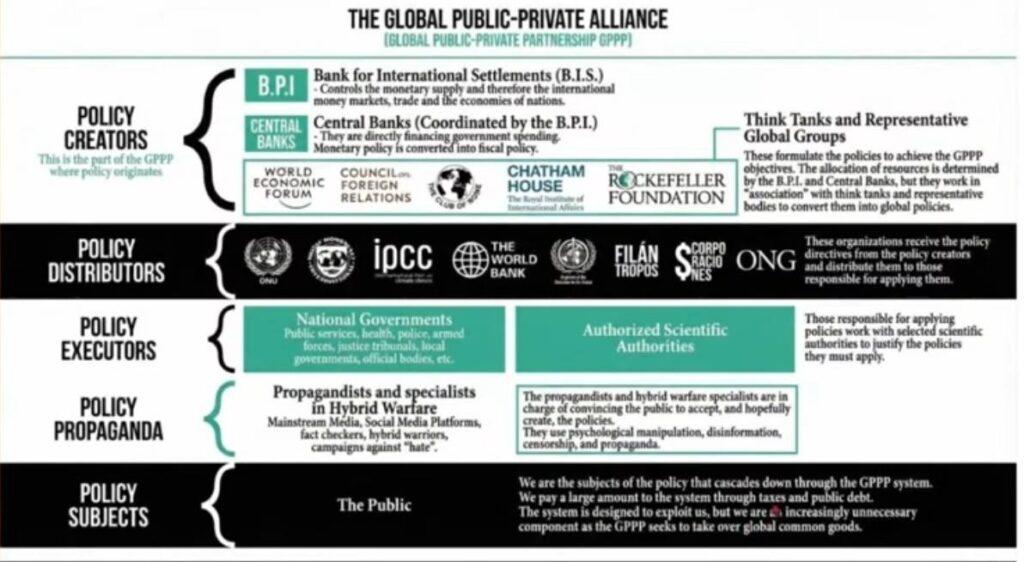
Clips from the World Economic Forum meeting make it clear that the intentions are to create a global asset register and to confiscate purchasing power through taxation. The asset register is intended to make it clear who owns what, where it is, and what money is being spent on. This is of course a prelude to an involuntary change of ownership over time. Assets are to be tokenised, and can then be traded fractionally. Misbehave (by government standards) and you can be fined a percentage of your home, with no right of appeal. Ownership becomes a conditional privilege, not a right, and the conditions will be set (unaccountably and non-transparently) by those at the top of the financial food chain, in order to implement their own agenda of continued control. Money will no longer be money, but will become glorified food stamps, with constraints on what can be purchased and also where, since digital currency will be fully programmable. Most people will end up on universal basic income (UBI) once the coming economic depression devastates the job market, and this is intended to be held at subsistence level, with no ability to save. The goal is total dependence on government for the majority of the population, because if one’s continued existence depends on government, obedience to the whims of the masters is far more likely. Say good-bye to privacy, freedom of speech, freedom of association, freedom of action etc.
The ongoing wars are one way to generate desperation, as they’re devastating the energy supply. On the way up, energy supply and GDP are extremely closely correlated, but on the way down, a substantial contraction in the energy supply will have an outsized impact due to the effect of fractured supply chains. The war has already reduced supply, both through disruption of transport and destruction of infrastructure. The latter guarantees that the reduction in energy supply will last for years, and may well be permanent. The inevitable price shock will price many people out of the market entirely. This is why the proposed 15 minute cities mean 15 minutes by foot. Sadly another rationale for war is getting rid of many military age males who might otherwise ’cause trouble’. Many countries are already talking seriously about conscription, especially in Europe where Russia is constantly, and erroneously, demonised as an invasion threat. Fewer mouths to feed in a depression is definitely a goal of the elites.
Other means to generate desperation are financial. Property taxes (ie rates) are skyrocketing, as is the cost of insurance, and the cost of living in general. Increasingly people on fixed incomes can no longer afford to live in their homes, even if the home is fully paid off. The next step is capital gains tax on unrealised gains, which can be applied even to a primary residence. Capital appreciation can be taxed even when the asset has not been sold in order to realise the gain. This will likely force assets, including homes, to be sold to pay the tax bill. This has already passed in the Netherlands, and will spread throughout Europe. Canada is also talking about introducing it. Red-zoning is another means of destroying value in order to force home sales. All governments have to do is to declare an area too risky to live in, and it becomes impossible to sell, rent, renovate, or insure a property, which of course collapses its value. Risks could be real (eg earthquakes, volcanos, floods etc) or imagined (eg sea level rise). The ability to mitigate or protect against the risk may not be taken into account.
One of the nastiest control mechanisms will be famine, which is inevitable due to the impact on fertiliser supplies, but will be unevenly distributed. 70% of American farmers cannot afford fertiliser, and may not be able to afford fuel soon either. The planting window is being missed by many, and those who do plant may find yields well down, or may not be able to afford to harvest. Food distribution also relies very heavily on diesel, and diesel will be in very short supply worldwide. In addition, fresh water may well be a problem in some places. If the war in the Gulf results in the destruction of desalination plants, millions in the region could die of thirst quite quickly. The American west is also short of water, with river flows drastically reduced and reservoirs at very low levels.
A very sharp contraction is coming, leading quickly to an economic depression. The best way forward is to be as independent of government as possible for as long as possible, and to wrap your head around the idea of living as simply as you can. The less leverage they have over you, the less chance they have to compell you to comply. Getting your expectations in line with what a curtailed reality can hope to deliver is important, because the right mindset is half the battle. Hope for the best, but plan for the worst. The future belongs to the adaptable.