
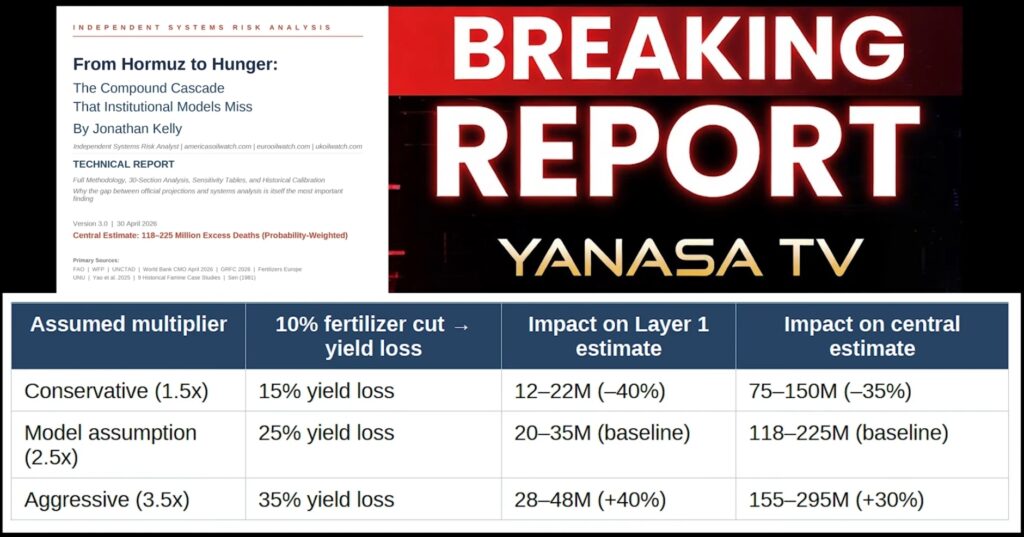
Most of the focus on the situation in the Gulf is on oil, for obvious reasons, but more attention needs to be paid to the consequences of the fertiliser deficit, many of which are already inevitable. The discussion in the headline video is around a new report called From Hormuz to Hunger: The Compound Cascade That Institutional Models Miss. While this report is based on the same mainstream data that other information sources are using, this one approaches the issue in greater depth, specifically looking at how different factors interact to compound the effects of each other, rather than addressing each in isolation. This is critical, as it reflects the ways that components of a predicament can amplify each other in feedback loops.
Prior to the war, there were already 650million food insecure people in the world, 10million of whom died of starvation yearly. Now the number of transits of the strait of Hormuz has fallen dramatically, from an average of 141/day to an average of 4/day. Both the energy and the fertiliser supplies are being heavily impacted, as 30% of fertiliser exports pass through the strait, including 67% of the urea fertiliser produced in the Gulf. A ten percent reduction in fertiliser use results in a yield loss of 25% or more. Sri Lanka discovered this the hard way a few years ago, and this time forty or more countries could find themselves in the same situation.
If the war stopped tomorrow, it would take 8-14 months to restore supply chains, meaning that some 25 million excess deaths are already a certainty. If it proceeds for longer then many countries will enter a sovereign debt doom loop, with crashing currencies and further catastrophic impacts. Fertiliser exports would stop, followed by food exports in a market fragmentation, as countries turn to self-sufficiency. August of 2026 appears to be the breaking point. If transits through Hormuz are not restored by then, consecutive crop seasons would be lost, guaranteeing a greater loss of life from both starvation and consequent vulnerability to disease. Mass migration and conflict would be inevitable.
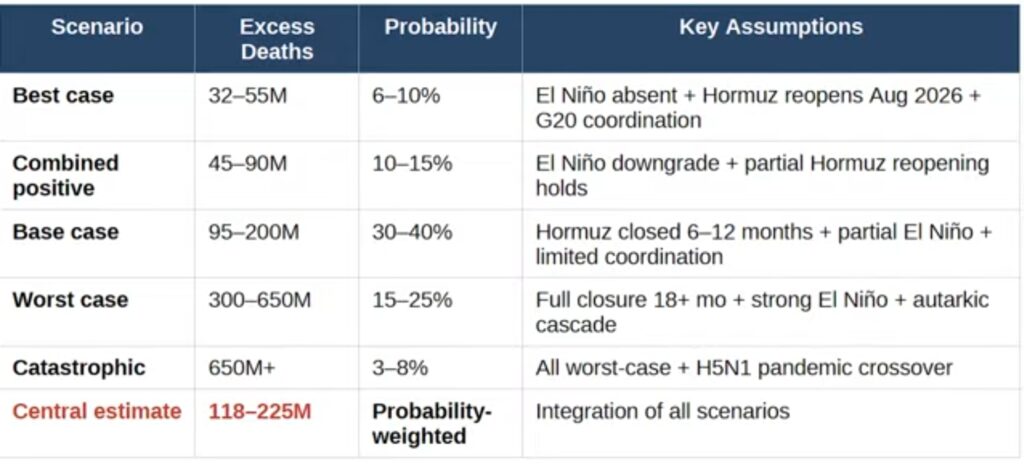
Compounding the predicament, a record breaking El Niño appears to be forming, and this typically diverts monsoon rains as well as causing drought in east Africa and Latin America. The solar cycle is also moving into a much less active phase, associated with cooler and cloudier weather. When there’s less incident UV, the stratosphere cools and the polar vortex weakens, leading to long cold snaps in unusual places. Late spring frosts and early autumn frosts could significantly shorten the growing season. The Earth’s magnetic shield weakens, allowing the penetration of more cosmic rays, which in turn cause cloud formation and reduced solar radiation reaching the ground. More clouds can lead to flooding, and greater humidity can lead to a higher incidence of crop diseases. A weak solar cycle could cause these problems for the full eleven years, but if we are in fact approaching a grand solar minimum, as solar physics suggests, then the impact could last for decades. This is what happened during the period known as the Little Ice Age. The report assess various scenarios, assigning probabilities to each. The base case is for up to 200 million excess deaths.

The entire agricultural system is about to be stress-tested, and may have to be substantially reorganised. Unfortunately, many more small farms will go out of business, and land ownership will consolidate in the hands of the already wealthy to a much greater extent. They are unlikely to consider the needs of the masses to be a priority, but their neglect of a mass of angry people with little left to lose could easily mark their own undoing, as has been the case before in history.