
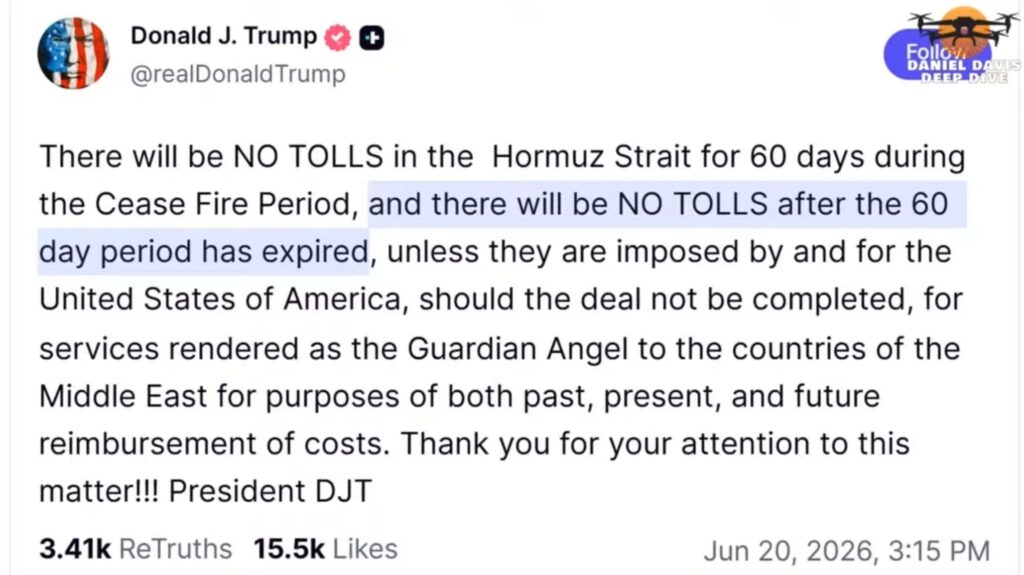
Trump signed the American surrender at Versailles, where Germany surrendered and agreed to pay reparations at the end of World War One. However, the Memorandum of Understanding (MOU) is already in trouble. Israel refuses to abide by it and has attacked Lebanon again, so Hormuz is closed again. In addition, Trump is already repudiating parts of what he himself recently signed after tremendous pushback from allies and donors at home. Among other things, he’s claiming that Iran will not be charging fees after the 60 day negotiation period, and that the US may charge fees. This is preposterous, and contrary to the MOU. The very idea that the US is any kind of guardian angel to the region is laughable, after having started the war and failed to protect any of its allies. Trump is once again trying to rewrite reality by fiat. Hormuz lies in Iranian and Omani territorial waters. They will retain control and charge for passage. The matter will not even be discussed with the US, which will have no role.
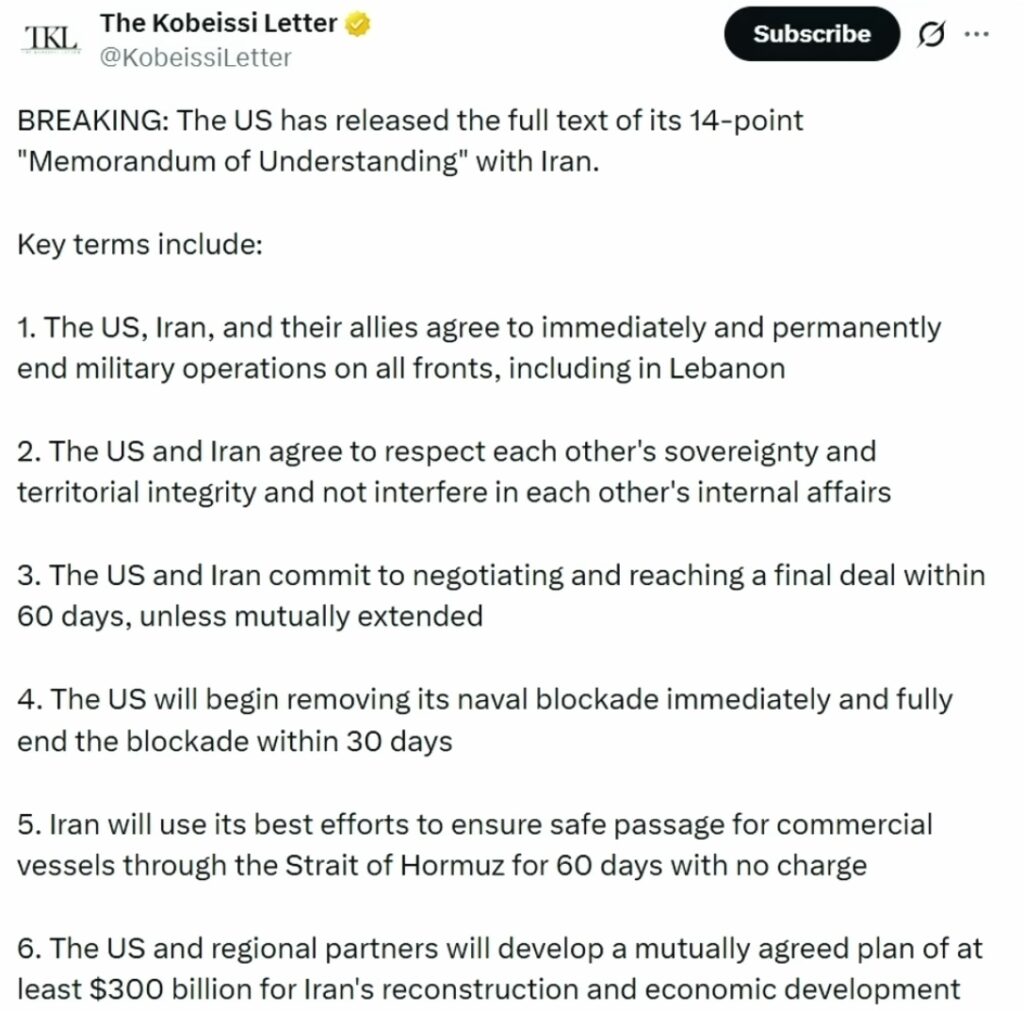
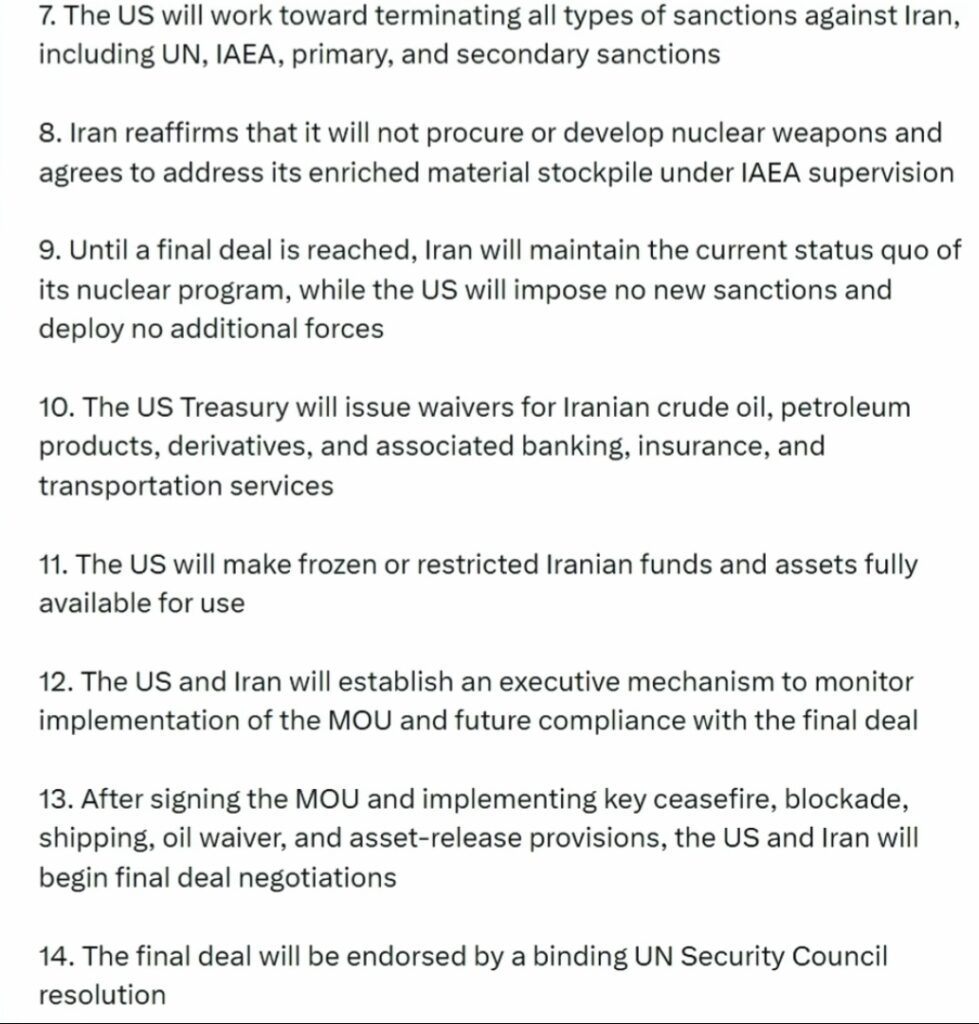
Trump had signed the MOU after being told that leaving Hormuz closed was leading to an economic catastrophy, which had been obvious to everyone else since the beginning of the war. He had been made aware, belatedly, that there were no further military options available, so ending the war was the only viable choice. Trump made it clear that his only real focus was the stock market, and that he thinks if the market goes up everything must be fine. He’s even on the record saying, in a jaw-dropping display of arrogance and hubris, that the stock market is more brilliant than everyone but himself. These are the terms officially agreed to:
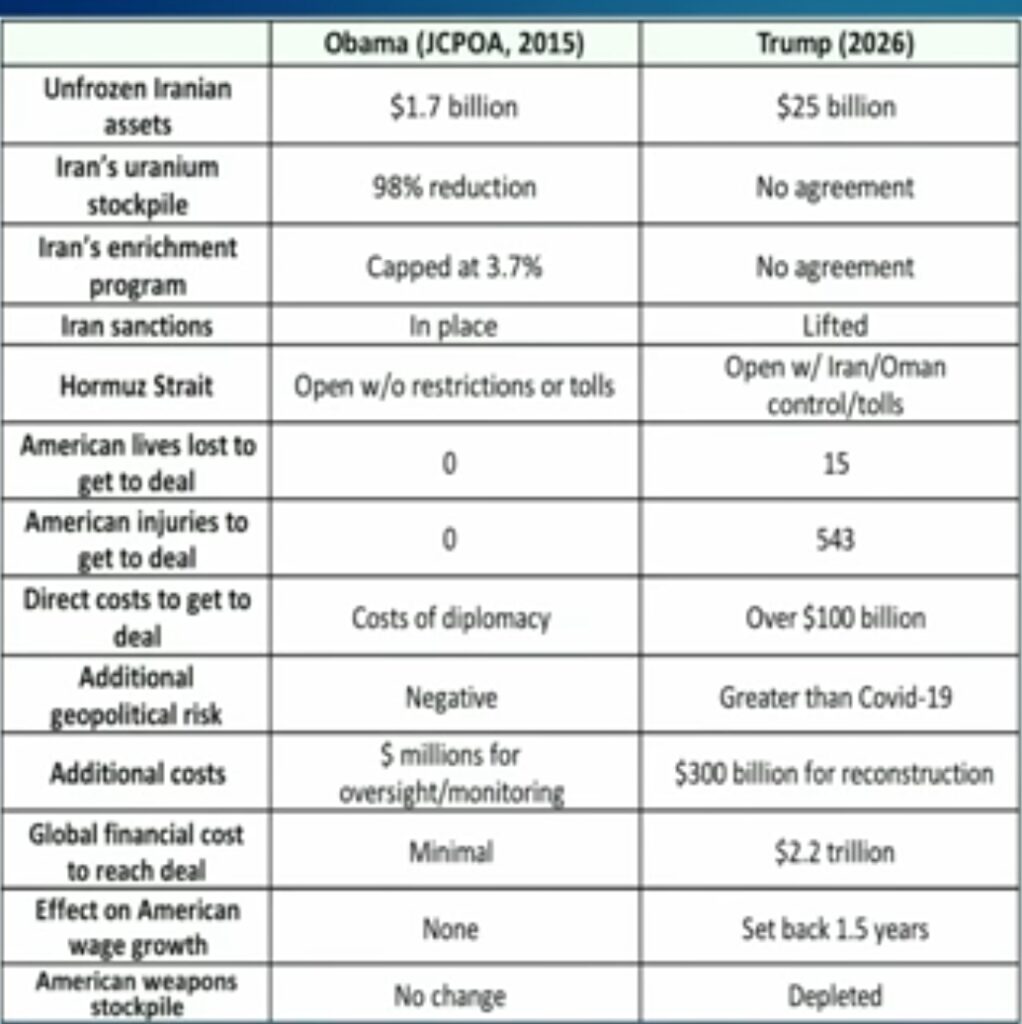
And this is the comparison between the MOU and the previous JCPOA:
Trump appears to believe that the signing the MOU has avoided an energy crunch and financial catastrophy, but this is wildly incorrect. The ships trapped in the Gulf will need to queue up to leave, which will take weeks. Then they’ll need to head back to port for maintenance, for instance to be cleaned of barnacles. The oil they’re carrying will have degraded, so must be tested and perhaps blended before delivery, which will then take weeks before destination ports are reached. The energy crisis will last well in to next year, and likely longer, even if the agreement is fully adhered to, which is currently looking unlikely. It will be exacerbated by a demand spike as all countries will be wanting to build large reserves as insurance against further conflict and disruption. Supply will be lower than before, perhaps permanently due to damage to shut in fields and risk aversion leading to insurance problems. Lower supply combined with higher demand is a recipe for extremely high prices. This will inevitably lead to rationing and ordinary people being priced out of the market in many, if not most, places.
The energy crisis is going to lead to financial crisis as well, as explained here:
Turkey is selling gold, because it needs to buy diesel. It already sold its US treasuries, and is now selling off what it should most want to be keeping. It’s not doing this because it wants to, but because it has no choice. It needs the energy. Many other countries are about to find themselves in the same boat. The countries that are the most vulnerable are those which import most or all of their energy and which keep their reserves in dollars. High energy prices combined with dollar shortages are going to force them to sell whatever they can in order to buy what they must.
If vulnerable countries begin to sell US debt, it’s going to begin to look increasingly risky. Selling pushes down the price, meaning that early sellers benefit most. Selling feeds fear and fear in turn feeds more selling. The risk is a rapid cascade in the bond market. This would force the US to raise interest rates in order to attract buyers, but the interest rate on the ten year bond is already close to a dangerous limit. If it goes much higher, the US will enter a doom loop, where its enormous debt begins to compound on itself. If the interest rate on the debt is higher than the rate if growth of the economy, the US will enter an exploding debt scenario.
Turkey’s sell off of treasuries began in March when the spot price for oil was much lower, and they only began to sell gold after selling 90% of their treasury holdings. There are currently price cushions due to stored reserves, but those are rapidly depleting, notably in the US, which has been stabilising the price by exporting its strategic petroleum reserve. The US is doing this in order to prevent a cascade of selling in the bond market if many countries were forced to liquidate treasury holdings at once. However, once the heavily manipulated futures price and the spot price inevitably converge, as those reserves run out in a couple of weeks, oil prices will spike and that cascade becomes increasingly likely. The US could choose to default on its debt or to print money, and given that choice it will print and destroy the dollar. Already gold has replaced treasuries as the defacto reserve store of value, and this will become increasingly clear over time.
Once countries run out of things to sell in order to get hold of dollars to buy oil or refined products, there will be massive unrest, and potentially revolutions. Sri Lanka is the poster child for this. In 2020 it lost its critical tourist revenue, and its crop yields fell off a cliff after an attempt at rapidly converting from conventional fertilisers to a fully organic system. It entered a polycrisis exacerbated by a dollar shortage, and this culminated in the leader being forced to flee the country after a period of tremendous unrest. Fertiliser will also be an issue this time, as much of this also comes from the Gulf and is also blocked. It’s orice will spike as well, and it may not be available at any price. If this dynamic was occuring simultaneously in many countries, as it very likely will be, there would be no one to come to the rescue this time. Crunch time is rapidly approaching. Brace for impact.