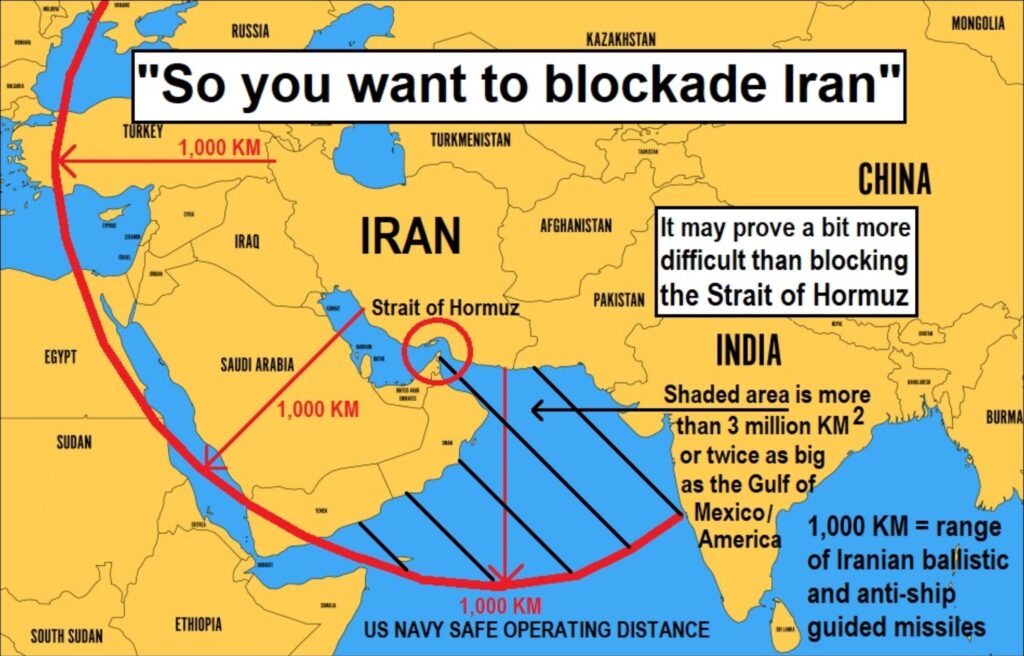
Iran has established what other call a blockade of the Straits of Hormuz, but is actually a tollbooth, allowing the ships of non-belligerants to pass through, for a price, but blocking the ships of hostile nations. It has stated that the tolls will provide for reconstuction of damaged infrastructure, in lieu of reparations which are unlikely to materialise. Thismis not an unreasonable position to take. In response, the American regime has decided to institute its own military blockade of shipping exiting the Straits, with their warships kept at a distance theoretically beyond the reach of Iranian missiles. It initially said that all shipping would be denied passage, but then clarified that it seeks to prevent any Iranian oil from being exported, and intends to commandeer any ship that has paid an Iranian toll.
The US, which is a failing empire, is attempting to prevent the rise of the empire in the ascendancy, namely China, by cutting off its energy supply, much of which comes through the Straits of Hormuz. This is called Thucydides Trap, and it never works, but always leads to unnecessary destruction. Of course the destruction of Iran is also a goal, since Iran has substantial energy resources and a non-Rothschild central bank, meaning that it remains sovereign in a world that transnational capital is attempting to gain full control over. This cannot be tolerated by those trying to install a New World Order under their own control.
Such a blockade is going to be very militarily difficult, if not impossible to put into practice. The mere attempt signals that the era of free passage on the high seas is over, and piracy is making a comeback.
Apart from the logistical difficulties, this prolonged interdiction of passage is going to lead to massive crisis in Europe, South East Asia , and Oceania, all of which will be facing the worst depression in living memory, along with widespread famine. The US doesn’t care about collateral damage, but other parties might, and they may take actions of their own, and those actions could initiate a wider spiral of escalation. Already other choke points are being considered for tolls by a range of states, meaning that international trade would either become much more expensive or could even cease almost entirely. Thisn s exactly what happened in the Great Depression if the 1930s – neo-mercantilism, gunboat diplomacy, trade wars, piracy etc – all of which caused trade to collpase by 66% in two years, and we’re far more dependent on integrated global trade than they were back then.
The many million of people in affected regions will be needing a Plan B, and it will need to be devised and implemented quickly. It will need to come from the grassroots, because the wealthy will only care about themselves. If the rest of us want to survive, we need to look after ourselves and our communities. We’ll need to pool resources and get out of our comfort zone in order to recreate the human connections our grandparents had. If we work together we may be able to remain independent of the slavery system that those at the top of the financial food chain are trying to impose.
Get out from under any leverage the system has over you if you possibly can, even if it means making significant sacrifices. Debt is the most obvious point of leverage. Families may be able to pay it off by consolidating, because the older generation typically has all the assets while the younger one has all the debt. The older generation can cover the debts in exchange for being looked after as their pensions and free healthcare disappear. Gain control of the essentials of your own existence if you can – food, water, energy, and shelter. In a crunch, those are the only things that matter. Dependency is leverage against you, and therefore vulnerability. Communities may be able to achieve relative independence collectively, even if individuals can’t. You will need to ride out the crunch and then rebuild, albeit at a much lower level of material prosperity. Your expectations will need to be in line with what reality can hope to deliver, but in the process we can all rediscover what it means to be human.