
Chris Martenson is an excellent, data-driven energy analyst. Energy is the ability to do work, hence energy and GDP are extremely tightly connected. The coming energy crisis will be the worst in human history, as never before have we had so far to fall in such a short time. The pace of change will be exceptionally difficult to adjust to. Oil is the lifeblood of the economy. Prior to the war we produced about 86 million barrels/day, but now we’re down by 10million barrels/day. Over the 48 days of the war, the world is missing 480 million barrels of oil, which cannot be made up later. The world last produced 76 million barrels/day in 2011, when the global economy was 36% smaller than it is today. GDP will be forced back to that level in a rapid supply shock, and the longer the war and disruption go on, the worse the situation will get. As the war is unlikely to be over soon, and disruption would continue for years afterwards, a global economic depression, with massive demand destruction, is now guaranteed.
So far pending deliveries have been made and reserves are being drawn down, so the crisis has yet to hit, but it won’t be long. Countries with little in the way of reserves, or reliant on long supply chains will be particularly vulnerable. Producing and exporting countries are likely to cease exporting in order to keep their reserves for themselves, further reducing supplies available to others. Refining capacity will be important, in order to produce specific fuels and feedstocks. The lack of it will be a very significant problems, as cargos of finished fuels will be in high demand and will go to the highest bidder. In a very few weeks, prices are going to spike considerably, and availability is going to be a major problem. Supply chains for many products are going to be substantially disrupted, perhaps permanently. Once a scarcity mindset kicks in, fuel hoarding will be rampant, for those countries and consumers able to afford it.
Besides the war itself, a significant amount of energy infrastructure around the world has recently been destroyed, particularly in Russia and Ukraine, but also refineries and gas storage in places like America, Mexico, and Australia. In addition, fertiliser plants have been exploding, and fertiliser is also in acute shortage due to the war and its blockage of transport. The scale of the destruction and the timeframe suggest that these were not all accidents. As Chris Martenson says, “once is an accident, twice is a coincidence, but three times isene y sction”. It seems that the global elites have decided not to waste a good poly-crisis, but to accelerate it in order to push their agenda of depopulation and control. Demand destruction, immobilisation, and control over the food supply are foundational apects of Agenda 2030.
A wide range of hydrocarbons are now referred to as petroleum, but the longer chain hydrocarbons are the really neccessary ones for the global economy. Short chain hydrocarbons are not oil and cannot be used to produce the diesel, kerosene and bunker fuel that keep the world moving. Without these products, industry, agriculture, shipping, air travel, and distribution throughout the economy would grind to a halt. The US is fond of bragging about its energy reserves, but it produces mainly short chain hydrocarbons, which it exports, and must import heavier grades. This is the primary reason for its invasion of Venezuela, although it will take a long time to bring in the very heavy grade Venezuelan oil in a meaningful quantity. Oil from Iran and Iraq is perfect for US refineries. The US remains a net energy importer, exporting about 4million barrels/day and importing 6million.
Refineries are designed for specific grades of crude, and cannot easily be retooled to operate on different inputs. The outputs they’re designed to produce are spoken for in many different and complex supply chains, so any retooling of a refinery would disrupt countless aspects of the economy. The supply chains are too complex to be adequately modelled, so specific results and knock-on effects are impossible to predict accurately.
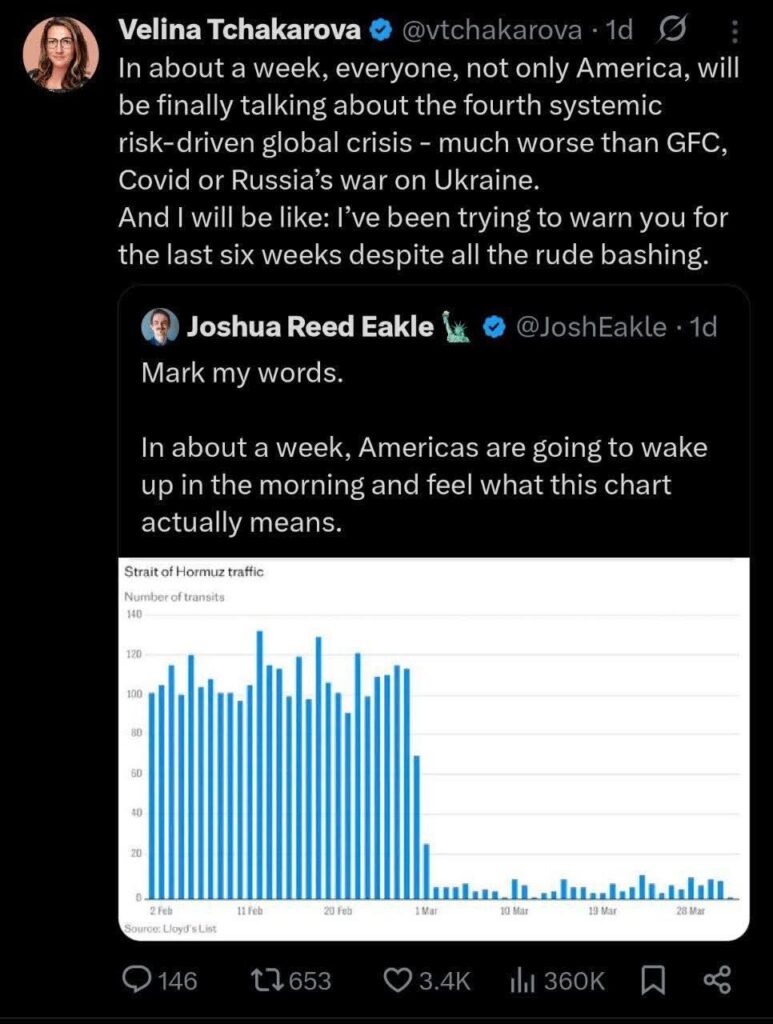
Because the war has caused a virtual ceasation of transits through the Strait of Hormuz, production was backing up in the Persian Gulf. Once storage was full, production was shut in, but this is problematic, because once the fluid injections guiding the oil towards outlets have ceased, the oil spreads out again within the field, and may not be able to be concentrated in the right area. In other words, production shut ins damage the field, and if restarted, production would be at a permanently lower level. Production of some 8-9million barrels/day have been shut in in the Gulf countries.
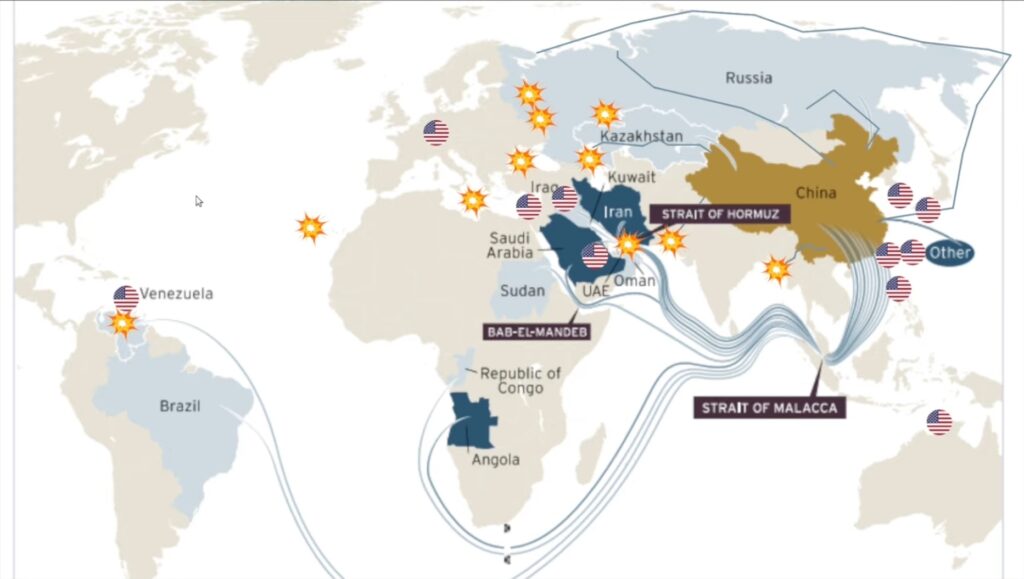
The US currently seems fixated only on their stock market, which is no indicator of the health of the real economy, and is currently elevated artificially by the bubble in AI stocks, which resemble a circular firing squad of financial engineering. The American regime is constantly manipulating the market and raising expectations skyhigh by spinning economic narratives that bear no resemblance to reality, and when reality asserts itself, it will come as a tremendous shock. Collective dashed expectations are extremely dangerous, especially in a highly polarised country with more guns than people. The regime is currently trying to control the flow of global trade into the future by attempting to control all the major maritime choke points, primarily with a view to halting the rise of Asia in general and China in particular. A deal being negotiated with Malaysia and Indonesia could confer control of the Strait of Malacca, which is the most critical in the world.
This oil shock will be larger than all previous ones combined, and it will happen at the same time as 20% of LNG is offline, fertiliser is missing for planting season, as well as sulphur for extraction, helium for computer chip manufacture, and many other critical inputs for the global economy. The real crisis has not yet begun, but it will start soon. Far too many people are energy-blind, and sleepwalking into disaster completely unprepared. Awareness must be raised, and communities must band together for mutual aid.