
There is a substantial difference between the oil price in the paper market and that of physical oil for delivery. The paper market is being manipulated to manage the price and keep markets calm, hence the scale of the coming energy emergency is not being accurately reflected. In other words, the market is not pricing in the actual degree of risk. In contrast, the physical market, where prices are substantially higher, is exhibiting a form of panic as the supply shock looms. Asia is now receiving only 6% of its normal amount, and both Australia and New Zealand are down stream from Singapore, Malaysia, South Korea and Taiwan, where their supplies of finished fuels come from. None of these locations have much in the way of reserves of their own, and so will not be sending supplies further along the supply chain. Australia has already received its last shipment. South Korea has already declared a state of emergency and is warning of an end to modern life.
At some point in the not too distant future, the paper and physical markets will be forced into convergence. Bets placed in the options market that the price would fall, due to misplaced optimism around peace talks or far too much faith in Trump’s manipulative pronouncements, are going to be forced to buy when the option runs out, and they will have to buy at the spot price. This is short squeeze, and it will be very painful. At that point a price surge is extremely likely. The US will likely be the last to feel the effects, but not by much, as the crunch will be global.
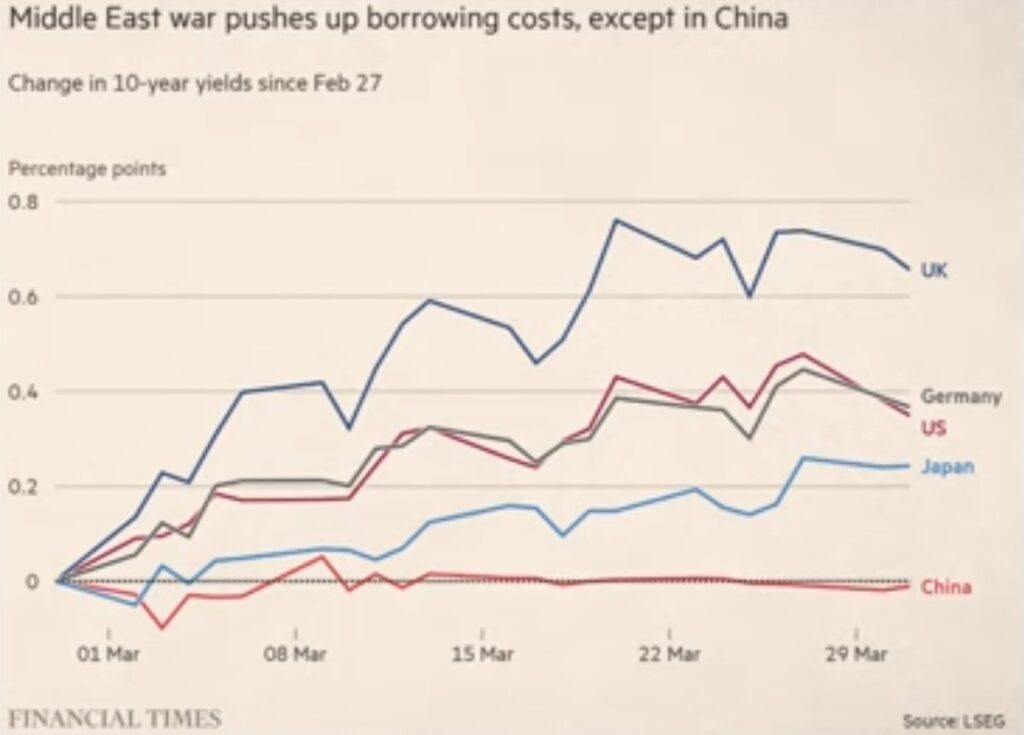
Bond markets show that risk is rising, with the exception of China, which is now being perceived as a haven of relative safety. China has substantial oil reserves and is much less vulnerable than most of the rest of Asia. However, the US is acting to cut off China’s supply in as many ways as it can, with export blockades from suppliers to attempting to gain control over vital shipping choke points. The Strait of Malacca is the most critical, and the US is seeking control over it through deals with Malaysia and Indonesia. US Treasury Secretary Scott Bessent has explicitly said that China is the target. China may now begin to provide its ships with a military escort as a result, daring the US to act against them. China has critical leverage over the US due to its control over rare earth elements necessary for American military production.
The US appears to be moving towards using their navy to enforce a global protection racket, extorting the rest of the world in a form of piracy. It’s doubtful whether this would be at all possible though, since the US does not have military superiority compared to the rest of the world combined. In fact the perception of US military prowess has been signifcantly dented due to its failures in West Asia (ie the Middle East). First they failed to deter Ansar Allah (ie the Houthis) from controlling passage through the Red Sea. The declared victory and left, but the actual result was obvious. Now they’ve failed to defeat Iran and are failing to fully contain shipping in the Gulf of Oman. The ships cannot approach the coast of Iran or they will come within firing range. The tentative ceasefire is almost over, so their ships will have to retreat further and be even less effective. The psychological warfare of issuing threats will only go so far if not backed up by actions.
To add insult to injury in the energy markets, a whole series of refinery explosions have occurred in recent weeks all across the world, on top of the destruction of Russian infrastructure by Ukraine (as a proxy for NATO). This cannot be a coincidence. Some entity is attempting to force the world off fossil fuels, in line with Agenda 2030. Given the scale of the damage, repairs, if possible at all, would take months to years, so a global supply shock more severe than all previous oil shocks combined is guaranteed.