
The hype around AI has been relentless, and the billionaires who own the companies working on it have seen their wealth soar. Companies in the AI space claim to be worth staggering sums, and several are about to attempt an IPO in order for their founders to cash out at the top (by fraudulently using pension money as their exist liquidity as explained in orevious posts). Those founders know perfectly well the corrosive effects the AI boom is having on society, but they have no concern for the ordinary people affected. Their goal is to secure sufficient resources to survive the dystopian society they’re helping to create. The point of the AI rollout is to create a technocracy, thereby depriving the population of agency by surveilling and controlling every aspect of life in order to monopolise decision-making. The billionaires, who seek to become trillionaires in the process, plan to hide out in their bunkers while any semblance of a coherent society disappears.
Ordinary people have been told that AI will inevitably be involved in every aspect of their lives, and will likely cost them their jobs. AI use has increased, partly because bosses are forcing employees to use it, partly because it does have some significant uses, and also because many people are becoming addicted to it interacting with chatbots that always praise them. The epidemic of loneliness makes the latter seem attractive, but it can lead to AI psychosis.
AI research is not science, as results cannot be replicated due to unstable hardware. Failure modes cannot be traced. Since it isn’t possible to know how an AI arrived at its position, there’s no way to know if a strange result might be indicative of something real and interesting, or simply a result of a chip malfunction. Unfortunately, companies are finding that AI’s tendency to hallucinate – confidently stating incorrect ‘facts’ – means that all output must be checked by humans, and this tends to take longer than having a human perform the task in the first place. Extensive reliance on AI is actually reducing productivity, and if mistakes are missed by human fact checkers, those mistakes can become very expensive. AI use in general is becoming increasingly expensive, with no way to calculate return on investment. Companies are billed for the number of tokens they use in a month, and the cost is steadily increasing.
The sense of inevitability created by the narrative the billionaires have been pushing had led to fatalism and a general sense of powerlessness. Data centres are being built with no regard to the various impacts on the area and its population, and these impacts are significant. They are heat islands, they create a constant humming noise, they’re far too bright at night, they use enormous quantities of electricity so local people’s bill are skyrocketing, they require huge amounts of cooling water but are often built in arid regions and compete with homes for scarce water, and the generators that power them emit toxic fumes. They can be built right next to residential neighbourhoods with no consultation, and are adversely affecting people’s health and the value if their properties. The government designates them as a matter of national security in order to override planning legislation.
From Collective Evolution on Facebook:
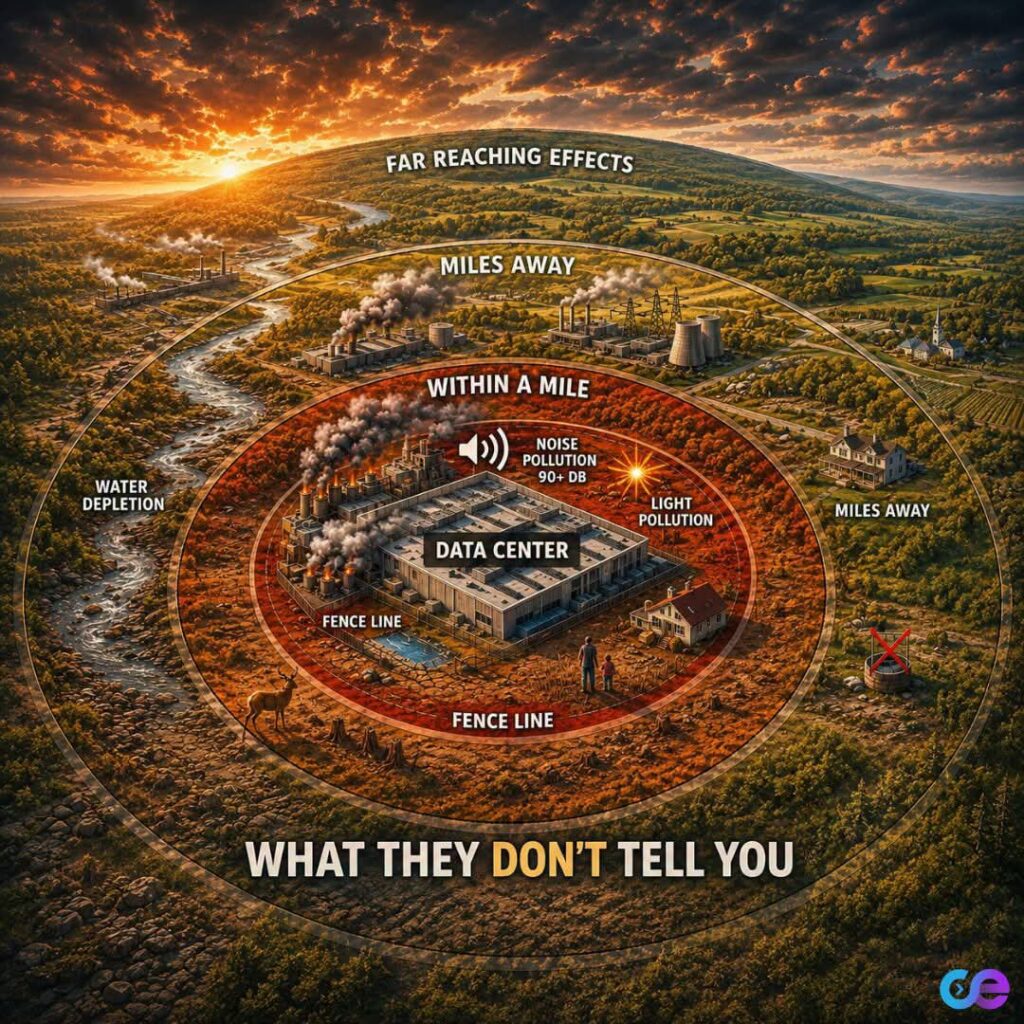
What a Data Center Actually Does to the Place You Live – They tell you it’s just a building full of computers. Here’s what they don’t tell you.
AT THE FENCE LINE:
The air around a data center is not the same air you grew up breathing. These facilities require diesel backup generators by the dozens, sometimes hundreds, and those generators release fine particulate matter (PM2.5) and nitrogen oxides (NOx) that are directly linked to asthma, heart disease, and respiratory illness. We’re talking 200 to 600 times more nitrogen oxides than a natural gas plant produces. (World Resources Institute) At the xAI facility in Memphis, a Time Magazine investigation found that nitrogen dioxide levels in surrounding areas measurably increased after the facility opened.
The noise never stops. Internal noise levels can reach up to 96 decibels, well above the 85 dB threshold considered harmful to human hearing. (PubMed Central) Neighbors near a Virginia facility reported 90 decibels at their homes. One resident said he can no longer open his windows. Another put mattresses against the glass to block it out.
The light runs all night, disrupting the natural circadian rhythms of the body, including melatonin production and sleep cycles. (EHP) Sleep disruption, chronic stress, hearing loss. These aren’t hypotheticals. They are documented outcomes in communities that said yes before they understood what they were agreeing to.
WITHIN A MILE:
The land changes fast. The average data center site in 2024 covered about 224 acres, roughly 450 football fields, which is a 144% increase in footprint since 2022. (World Resources Institute) Farmland gone. Forests cleared. Viewsheds destroyed.
The water starts disappearing. A mid-sized data center uses roughly 300,000 gallons of water per day, the same as 1,000 homes. (Nixon Peabody) Between 80 and 90 percent of that comes from the same surface water and groundwater sources your tap water comes from. (Fwpcoa) Most of it evaporates in cooling towers and never returns.
Wildlife changes too. Researchers describe data centers as potential “sensory danger zones,” places where light and noise levels exceed the thresholds at which species experience measurable fitness consequences. (National Wildlife Federation) Animal communication breaks down. Migration patterns shift. Nesting fails.
MILES AWAY AND DOWNSTREAM:
The water table doesn’t stop at the property line. Heavy groundwater use can deplete aquifers in ways that threaten ecosystems and long-term water availability for entire surrounding regions, not just immediate neighbors. (Waterplan)
The power plants feeding these facilities pollute far beyond the data center itself. Data centers increasingly rely on large-scale plants that are now being co-located nearby to avoid grid upgrade delays. (arXiv) Whatever that plant burns, your airshed absorbs.
A September 2025 study found that air pollutants from data center operations increase rates of respiratory and cardiovascular disease, and elevate cancer risk in nearby communities. (EHP)
However, the fatalism is beginning to dissipate as resistance grows and collective action begins to show some successes. The Epstein class of billionaires regards the rest of the population as somewhere between livestock (if they’re useful) and pond scum (if they’re not), so they tend not to recognise that ordinary people have agency and are capable of collective action. The pushback has begun in earnest, and it coincides with a growing awareness of the fact that the companies involved are actually consistently losing money and that the hype is just a gigantic bubble. In addition, people are realising that the billionaire class is changing the rules in order to force these loss-making companies on to the stock exchange, which will allow the founders to cash out through an IPO at the expense of ordinary people’s pension funds, which would become exit liquidity. This is evidence of the staggering degree of contempt the founders have for the rest of the population, and people are taking note.
The billionaires are attempting to force through compliance despite opposition by buying political influence, following the model used by the crypto industry. Huge amounts of money are poured into political campaigns, dark money channels are deployed, Congress members are bought, local officials are bribed, and influencers are paid to push the narrative of AI inevitability. The Trump administration’s policies are for sale to the highest bidder, so Trump, who is entirely transactional and driven by personal profit, has facilitated everything his techbro donors wanted. The level of corruption is unprecedented. The techbros are trying to create a fait accompli by bulldozing their way through the consent process quickly enough that opposition can’t coalesce into an effective opposition in time, but they appear to be losing the race. The AI bubble might be on the verge of implosion, which is how all bubbles end.