
Every other generation or so, humans rediscover the magic of leverage, once the consequences of the last time have been forgotten. Leverage allows for outsized gains during expansion periods, but at the cost of increased risk, because it also creates outsized losses during contractions. Investors in the South Korean stock market are currently learning this the hard way, and they won’t be the only ones. As Andrei explains, in South Korea one is expected to have a good job and a house by a certain age, but house prices are now out of reach for young people. They’ve turned to the stock market – the Kospi – as their only option to accumulate wealth, and they’re employing a great deal of leverage to do it.
The South Korean market is highly concentrated in tech, with two companies – Samsung and SK Hynix – comprising 56% of the entire market. Until three weeks ago, it was the best performing market on the planet (up 200% in a year), driven upwards by enthusiastic, and highly leveraged, investors all taking the same bet – that AI spending would never fall. Then it occured to some people that AI spending MIGHT drop, which was enough to cause a crisis of confidence. As selling began, leveraged ETF accounts began to get margin calls, meaning that their margin debt was now too high in comparison with the value of their portfolio, so they would have to put up more cash or sell some assets. If they couldn’t put up cash, the broker would automatically sell assets at whatever price was available. As selling pushes down prices, more accounts get margin calls, which pushes prices down further. See the film ‘Margin Call’ to see how this works. The unwinding of leverage pushed the market down by 25%, and 10% of accounts were wiped out. The slide was only halted, probably temporarily, by the market being closed on a national holiday. There’s still a great deal of leverage left to unwind, and some contagion has already spread to other Asian markets. It could easily spread much further.
The US market has many of the same vulnerabilities. Traditional margin loans at brokerage accounts now represent 4.5% of GDP, which is the highest in history, although this greatly under estimates the true degree of leverage due to the many other forms of it available today. These are not tracked, so the true degree of leverage is unknowable. The top ten stocks of the S&P comprise 36% of the market, and they’re all tech-related companies taking the same side of the bet, as in South Korea. One company’s spending is another’s earnings in a giant loop of imaginary value. AI companies are spending like drunken sailors on chips, models, and data centres and being rewarded by investors for it, but these companies are all unprofitable. The mania will not continue forever, and once the confidence bubble is pricked the cascade of unwinding leverage will begin.
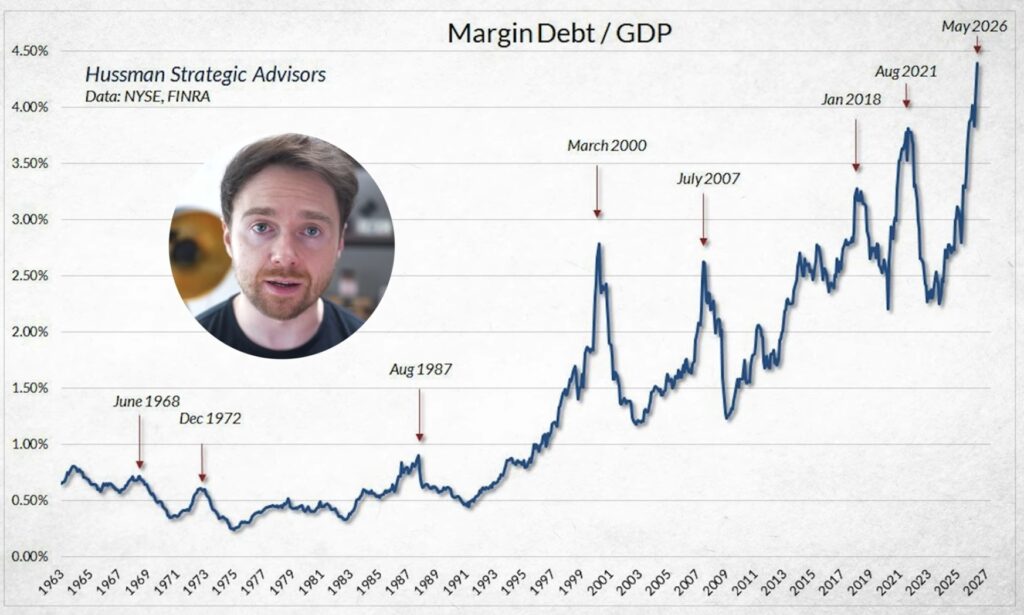
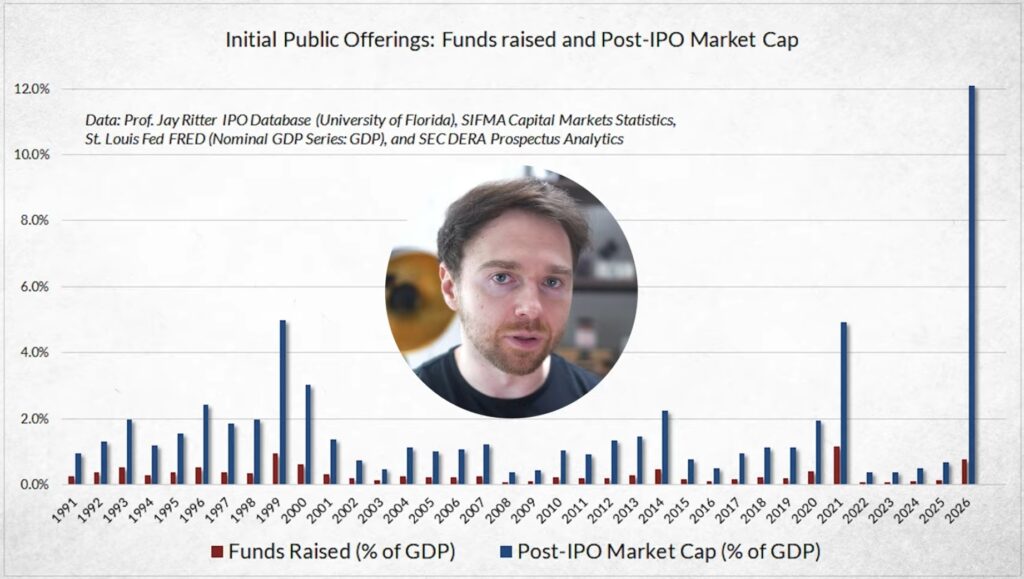
Peaks in margin debt are generally followed by a substantial crash. The hangover is proportional to the party that preceded it, and this has been the largest financial party in history. The market has become a gigantic casino. Now the insiders are looking for an exit strategy, which is what happens when they think the growth phase is over and they want to unload the remains on to an unsuspecting public. A record number of IPOs are planned, at skyhigh valuations that cannot be remotely justified. SpaceX managed to find its exit liquidity in the form of ordinary people’s pension funds, after rigging the rules of the NASDAQ, but the rest may not be so lucky. Watching for a fall in the capex of Microsoft, Amazon, Google and Meta could provide an early warning if the coming cascade.
Manias are not new. People become irrationally exuberent about a certain thing, as they did over railways in the late 1800s, or radio in the 1920s, they over-invest on hype, and then lose their shirts. The new technology that had been the focus does go on to shape the future, but the profits don’t go to those who built it. They go to those who built businesses around it after the crash. In this case though, that is unlikely to happen. The graphics cards in those data centres have a lifespan of very few years, then they need to be replaced. That means the expenditure would have to happen again and again. The data centres themselves are extremely controversial, as they blight the areas where they’re built with constant noise, fumes, and light pollution, as well as consuming so much power and water that people’s bills are skyrocketing. Continuing to build these enormous facilities is increasingly likely to lead to social unrest, which could halt the spending, and trigger the cascade. The moment of truth might not be that far in the future.