Israel doesn’t do actual ceasefires. It continues to kill indiscriminately in many ways, but may refrain from bombing civilians for a period of time. Israel regards Lebanon as part of its own territory, where it can act as it pleases. The Lebanese government is already firmly under its thumb, and has been so thoroughly disarmed that the army is incapable of defending its own territory. Only Hezbollah can do this, so naturally it is considered the enemy by both Israel and its Lebanese proxy government. Israel would really like to see civil war in Lebanon, in order to further destroy a state that it wishes to annex in its entirety into the Greater Israel project. Non-Jews are regarded by Israel as subhuman, possessing only 3/5 of a soul, while only Jews posses a full soul, and are therefore fully human and superior to all others. This is of course merely racist hubris, but this deeply held belief is driving Israel to commit countless atrocities against its neighbours. It believes that its only path to security is to render all other inhabitants of the region radically insecure. It has become a barbaric pariah state.
Israel could not do any of this without the full complicity of the US, which both bankrolls and arms it. While both American parties are fully bought and paid for by the Israeli lobby, only Trump was stupid enough to go to war with Iran on their behalf. All Israel has to do was tell him it would a quick in and out, like his criminal kidnapping of the Venzuelan president. Having convinced him to attack Iran, the Israelis now undermine any attempt to end the war, so Trump is trapped. Israel wants nothing less than the utter destruction of Iran, and won’t accept anything short of that. Meanwhile the IDF is sounding the alarm that it’s over-extended and beginning to collapse, and Hezbollah is inflicting substantial casualties on the troops invading Lebanon on a daily basis with fibre optic drones. Netanyahu is becoming increasingly unpopular due to his lack of success in achieving the full anihilation of it Israel’e perceived enemies, and will likely be replaced at the next election by someone even worse.
The US is paying an enormous price for its complicity. It’s international reputation is in tatters, as it’s now wildly perceived as the evil empire. It’s alienated all of its former allies by insulting, humiliating, and extorting them. It’s arms donations to both Ukraine and Israel, and its participation in the war, have substantially depleted its own stocks of weaponry. The US military is no longer the powerful force it once was. Its military industrial complex operates for profit, not victory, and much of its weaponry is obsolete in the age of drone warfare. The US has nothing resembling actual leadership. It has instead a bloviating pathological liar with zero understanding of any of the relevant issues, and seemingly has never heard of diplomacy. Diplomacy is relational, whereas everything with Trump is purely transactional. Trump does not believe in win-win scenarios. He must always win while the other side must lose, preferably humiliatingly. His profound narcissism is responsible for this behaviour. This approach is a recipe for disaster in global geopolitics.
Hezbollah is not a proxy of Iran, merely an ally. It only exists because of the earlier Israeli occupation of Lebanon (1978-2000), when Lebanon required the ability to defend itself. It ended that occuoation, and drove the Israelis out when they tried again in 2006. It is now working to drive them out again. Iran is including Lebanon in its demands for a full ceasefire because its goal is to secure peace across the region, and for that to happen, Israel, which is the cause of regional the destabilisation going back decades, must be reined in. Somfar the US, under its weak and fackless administration, refuses to do so. Israel is threatening to flatten an entire suburb of Beirut, but if it tries to do so, Iran will escalate against it. The farce of a ‘ceasefire’ is looking more fragile by the day. This war is by no means over, traffic through the strait of Hormuz remains greatly reduced, and the clock is ticking towards the inevitable global economic depression. The longer this continues, the more supply chains will fracture, and the deeper the depression will be.
This topic is highly controversial, with strong opinions on both sides. Two prominent and knowledgeable commentators on the war, Larry Johnson and Pepe Escobar, have been informed by a high level and credible source in Pakistan that Iran possess nuclear weapons and intends to conduct a demonstration in their own country. In some ways this would be no surprise, since it’s become obvious to many countries that possession of nuclear weapons is the only potential deterrent against imperial aggression. However, this is the rational position, and by no means is rationality the only factor in play.
Iran has had a religious injunction – fatwa- against nuclear weapons for many years, because under Shia Islam, it’s forbidden to harm non-combatants, which use of nuclear weapons would obviously do. The caveat to this declaration was that the position could only be reversed if Iran faced an existential threat. The fatwa was proclaimed by the former religious leader who was assassinated with much of his family on the first day of the war. His son (who was wounded in the attack and lost both parents, his wife, and child) now occupies the position, and may have a different view than his father. However, the process of altering a fatwa takes time, and there has been no evidence so far that this is happening. Iran could reasonably argue that it does now face an existential threat. Perhaps they could argue that mere possession of nuclear weapons is sufficient deterrent against aggression. If so, there may be no need to alter the fatwa unless actual use of nuclear weapons is being considered. Unfortunately, mere possession is likely not enough, as Russia has discovered over the last few years.
This is a critical issue, and it is not yet clear where the truth lies. The information from the Pakistani source could be in error, or could be a bluff. If a demonstration occurs, we will know. It would likely be underground, detectable seismically, so no airborne radiological contamination of the region would occur. Unfortunately one possibility is that if a demonstration were to confirm the existence of nuclear weapons, Israel may decide to deploy its own nuclear arsenal preemptively against Iran, likely sparking off a global nuclear conflagration. There have been many online discussions, which will be posted here for anyone who wants to look at the issue from all sides.
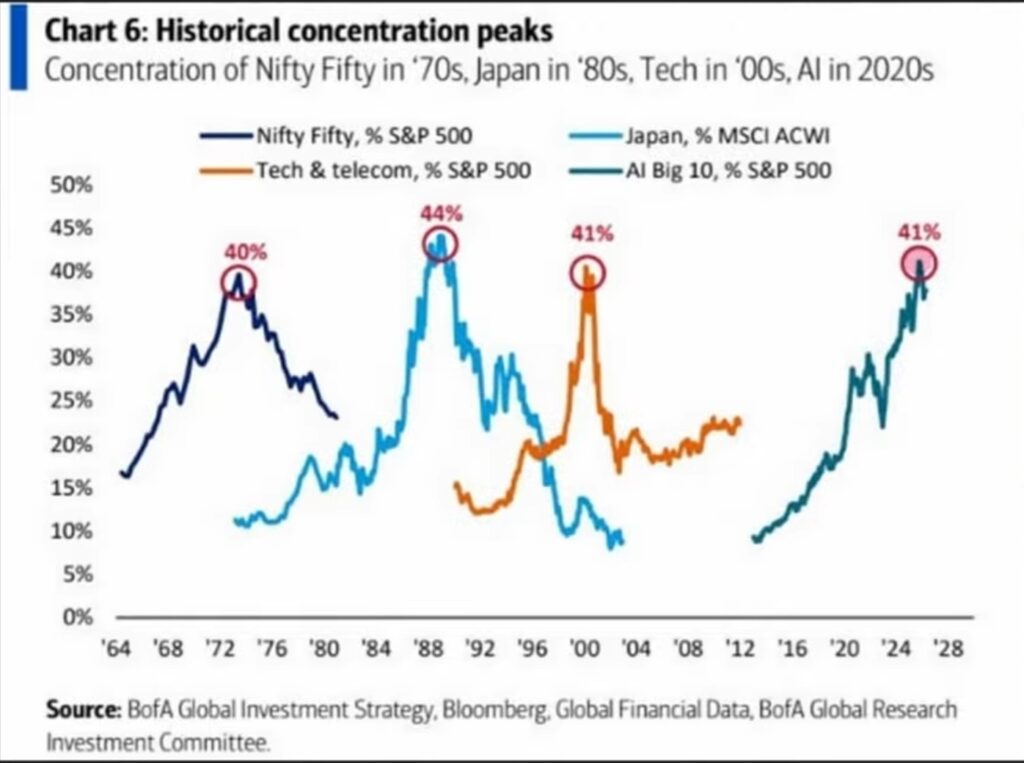
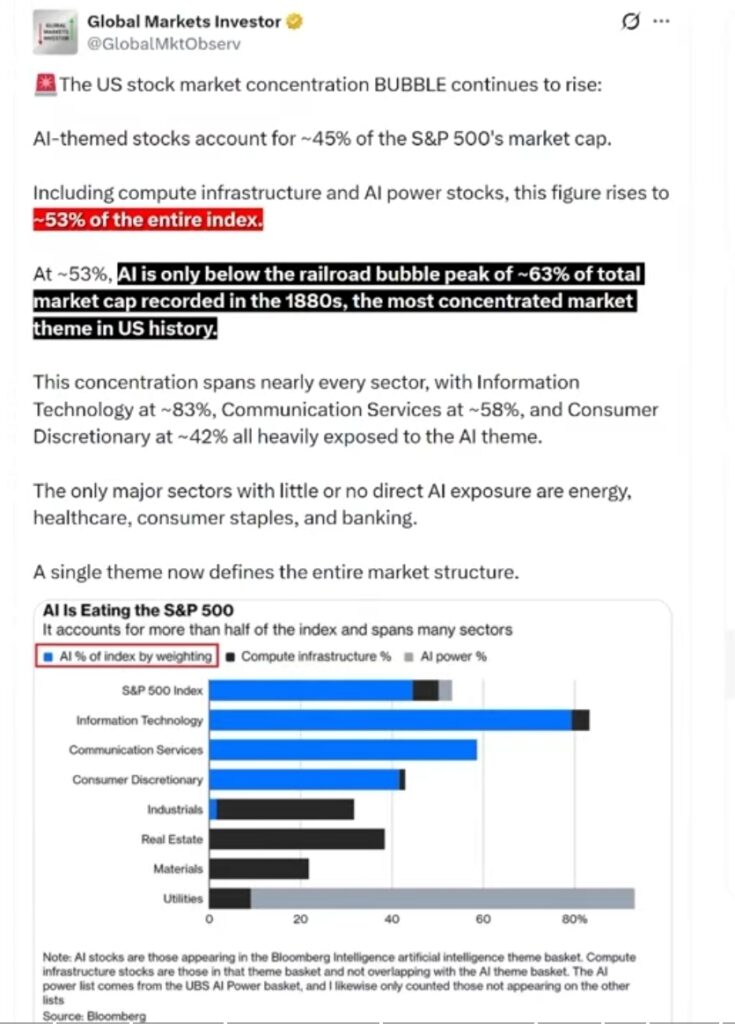
The AI hype has generated a bubble that has already matched many previous ones, and could yet go somewhat higher, but bubbles always end the same way – implosion. The hype over a new technology typically leads to irrational exuberance, which in turn leads to investors jumping on the bandwagon without first assessing the fundamentals. Momentum chasing without due dilligence is a recipe for disaster. The AI stocks now dominate the S&P index, but such an over-concentration is a red flag.
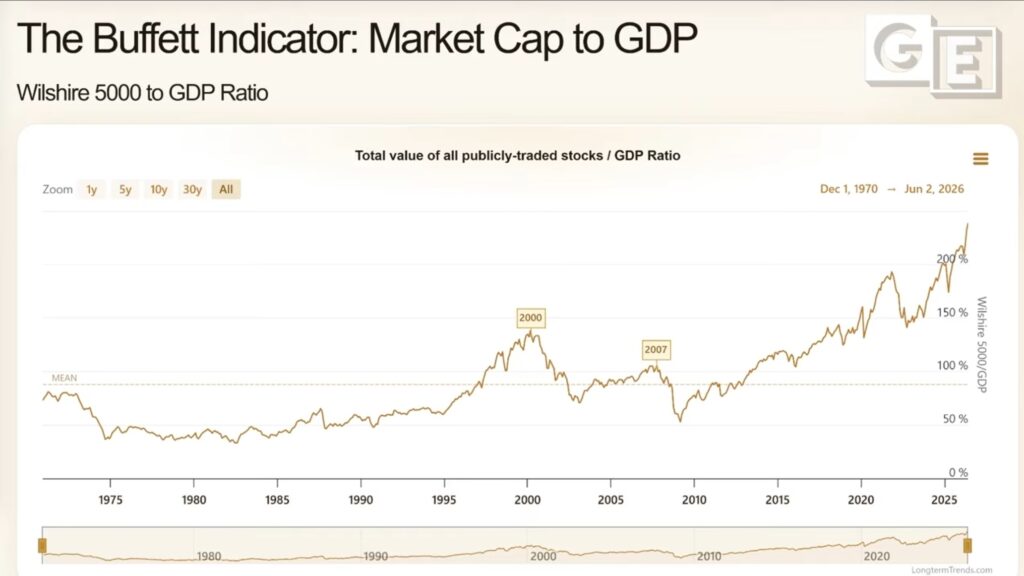
Warren Buffet guages risk by looking at market cap of all publicly traded stocks as a percentage of GDP, and it has now reached a staggering 240%.
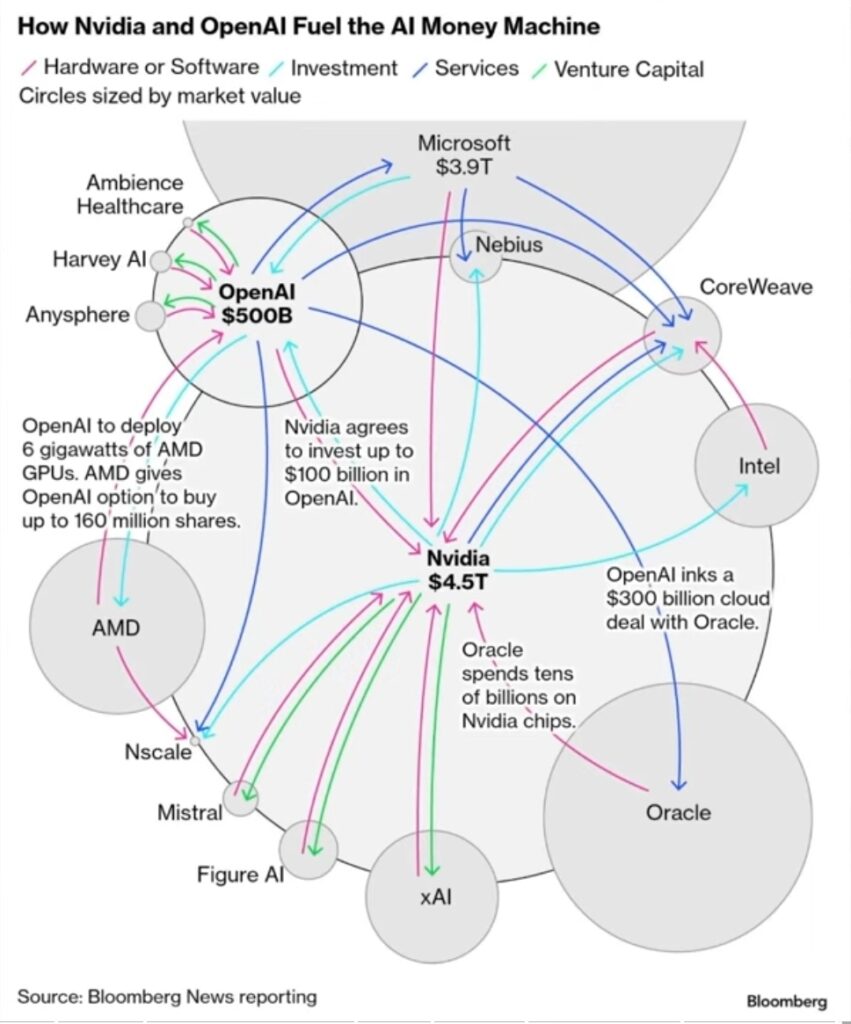
The entire AI sector forms a circular firing squad, with companies inflating each other’s value in a way that amounts to fraud. Nvidia is the one on actually making money, as everyone is buying their chips, but as the rest continue to burn through money, eventually their purchases sill be discontinued.
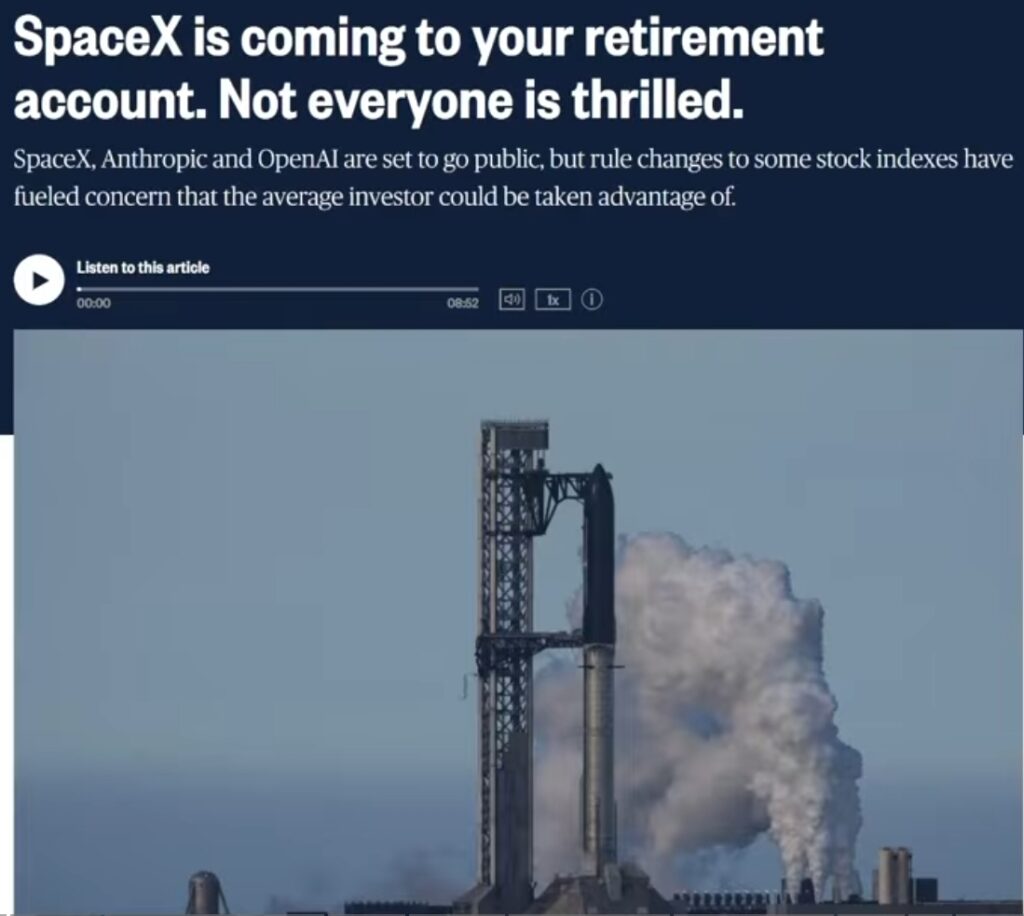
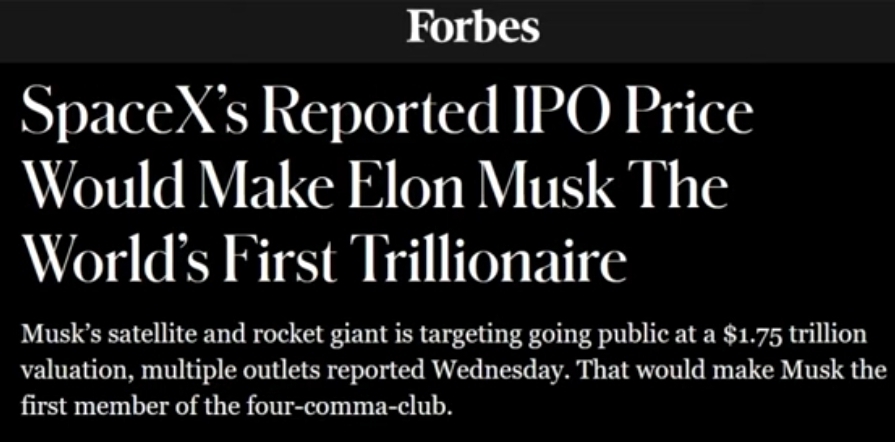
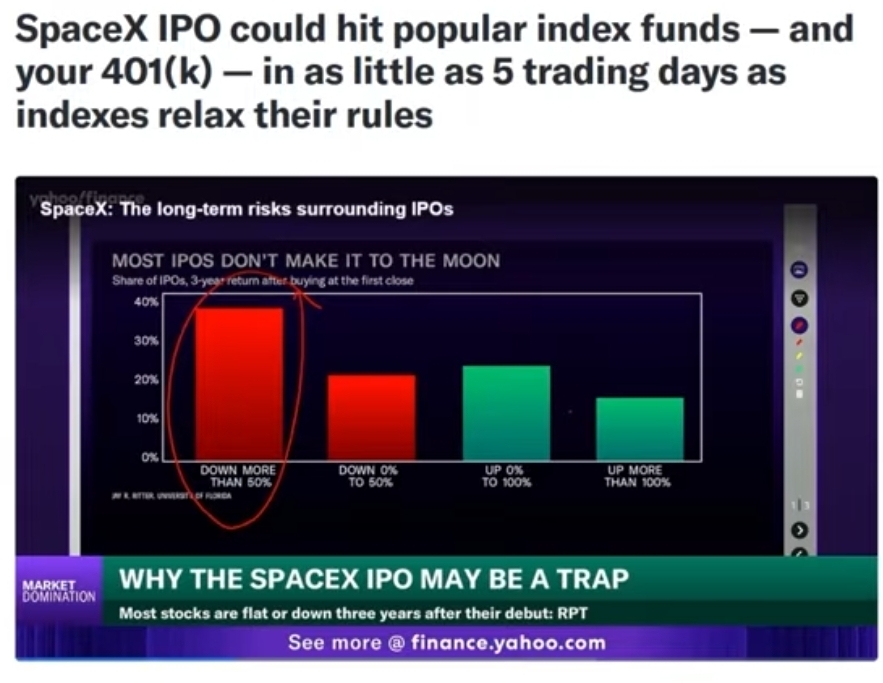
Several major tech companies are planning an IPO this year, but each of them consistently loses money. An IPO in such a case is an attempt to dump a money loser on the public, thereby achieving exit liquidity for the billionaire founders. Normally, a money losing stock would not be permited to join the indicies, but in an oligarchy like the US, the rules are made by the billionaires. Musk has managed to get the rules changed so SpaceX can join on a fast track. This will have the effect of index funds being forced to buy the stock on behalf of passive investors like pension funds. Open AI and Anthropic will follow suit later. In other words, the retirement accounts of ordinary people are being asked to bail out chronic money losing companies so their founders can walk away unscathed and even richer. Musk has his eye on being the first trillionaire. This is a grotesque financial fraud on the public.
Both Australia and New Zealand are facing acute economic distress due to the war in the Gulf. Both countries fully embraced globalisation, and benefited disproportionately from it due to being able to export resources into global markets. Both countries chose the economic efficiency of global wage arbitrage, allowing their manfacturing base to be offshored to places where wages were much lower, and then importing the value-added results. Unfortunately when economic efficiency is prioritised, under circumstances of relative global stability, resilience is sacrificed, and the cost of this is revealed when global stability comes to an end as it has done this year.
A just-in-time economy is a complex web of supply chains, fully dependent on enormous and constant flows of raw materials and goods. Energy is they key resource upon which maintaining all of this depends, and global energy supply is taking a major hit. The war has already made a great depression inevitable, and it shows no signs of ending any time soon. Those complex supply chains will fracture in ways far too complex to model accurately, and will likely never be reestablished due to permanent energy deficit.
When you benefit disproportionately from a comprehensive system, you also suffer disproportionately from its demise. Arguably the worst decision made by both Australia and New Zealand was to drastically reduce (Australia) or eliminate (New Zealand) their ability to refine oil in order to create the fuels that are the lifeblood of the economic system. New Zealand’s case is worse, since even with a refinery the country was critically dependent on imports of the heavy oil the refinery was designed to process. It was cheaper to import finished fuels from Asia, but the Asian supplers source their inputs of crude oil from the Gulf, and those inputs are no longer arriving. Exports of finished fuels are no longer available. Both Australia and New Zealand are about to be pitched into an unprecedented fuel crisis, but the populations are not being warned about what is coming.
Heavy oil (ie long chains of hydrocarbons) is essential for the production of diesel, bunker fuel and jet fuel. These cannot be made from lighter oils (ie short chain hydrocarbons). Diesel is particularly critical, and without it economies will grind to a halt across the board. Farming would not be possible, nor industry, mining, transport of goods, food distribution etc. The Gulf region exports heavy oil, as do Russia and Canada. Venezuela may eventually do so, once a great deal of capital has been deployed to create the necessary infrastructure. Oil from the Gulf has been reduced to a tiny trickle, and Russia’s energy infrastructure is being damaged deliberately due to NATO’s proxy war through Ukraine. Russia’s exports are also being blockaded and attacked by NATO. The US will absorb Canada’s supply, and Venezuelan tar won’t be available in quantity for years.
For any of those supplies to benefit Australia and New Zealand, they would have to find their way to our Asian suppliers, and they would have to be prepared to export it even as they’re experiencing shortages themselves. This is very unlikely. The result will be an acute and multifaceted crisis that no one is prepared for. Economic efficiency can be described as the straightest path to hell, as it means running a system with no margin for error – a system that has become extremely brittle. It’s the opposite of the resilience that can allow an economy to continue to function under pressure. Both countries are about to understand the consequences of having taken this path. A great simplification is coming, and it will be painful.
The Speaker of the House in the US is introducing legislation that would effectively combine American and Israeli security forces, and eliminate any form of oversight of the military relationship. Israeli security forces would be fully integrated into the American security complex as if they were the same country. IDF veterans would be treated as American veterans, and likely better, with full access to veteran benefits. The IDF is already training ICE brown shirts and police forces in the same brutal techniques they use against Palestinians. The administration and the Congress are fully Israel first. Anyone who opposes this agenda will be primaried, as Thomas Massie recently was, with unlimited amounts of money given to the opponent to buy the election. The neocon warmongers in charge appear to believe that American and Israeli interests are identical, but they are not. Israel is a strategic liability for the empire.
The combined forces of the two aspects of empire are attempting to complete the 2002 list of seven countries to be taken down. Iran was the last country on that list, as all the others have already fallen. This time the empire has drastically underestimated its opponent, and its allies, and has bitten off far more than it can chew. Central Asia, Russia and China are supporting Iran, and their support is formidable, if not obvious to most observers. Israel is being defeated in southern Lebanon, where it’s threatening to level southern Beirut in a fit of pique, as it’s already doing to the regions south of the Litani river. Netanyahu seems to be about to lose an election to even worse Israeli warmongers. The US is mostly out of conventional weaponry, cannot make more without Chinese rare earths, and so is resorting to a war of threatening words. The risk is the potential use of nuclear weapons, by either Israel or the US.
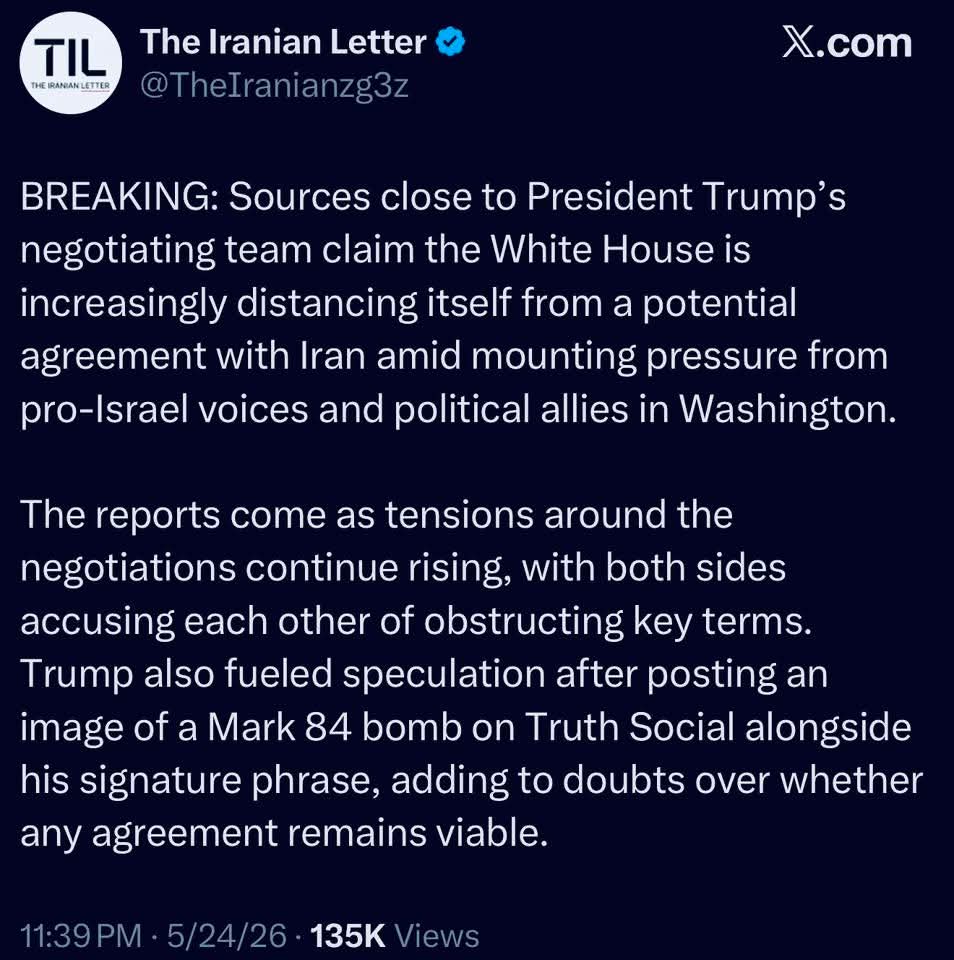
There is a growing realisation among the regime that the war has been lost. Even notorious warmongers like Robert Kagan (husband of the even more notorious warmonger Victoria Nuland) are going public with their condemnation of the conduct of the war, although in Kagan’s case he thinks they didn’t try hard enough. Trump is flipflopping almost every day, making up stories about imminent deals in order to manipulate the markets. There is, however, no deal to be had. The two sides are as far apart as ever, with Iran’s demands being quite reasonable, while the US is insisting on complete capitulation and full surrender of sovereignty. It can insist all it wants, but since it has no means to enforce such demands, humiliation awaits. In the meantime, Trump and his inner circle are making billions of dollars thanks to their market manipulation and other forms of obvious corruption.
Gangster Capitalism and Corruption in Trump’s America
Corruption has never been far from the center of American politics. Some of the most notorious scandals stretch from the cronyism of Warren G. Harding to the abuses of power exposed during the Watergate scandal under Richard Nixon. Yet many historians argue that what distinguishes What distinguishes Donald Trump from earlier corrupt presidencies is that corruption no longer operates behind closed doors, shielded by the liberal rituals of institutional legitimacy and the euphemisms of political decorum. Under Trump, corruption is performed openly as spectacle, celebrated as a sign of strength, wealth, vengeance, and personal loyalty.
Apart from losing the wars in both the Gulf and Ukraine, the Trump regime is also continuing to murder people in small boats around South America. It makes no attempt to acertain what those boats are carrying or where they might be headed. Many are likely just fishermen trying to earn a living. It’s extremely unlikely that they’re drug dealers, given the distance from the US, the size of the boats, and the amountof fuel they could carry. Even if they were, taking out those boats has done nothing whatsoever to diminish the flow of drugs into the US, or the demand for drugs. When the boats are bombed, survivors of the initial strike are then bombed again, so as to leave noe mbarrassing witnesses. These activities are obvious war crimes, but under Hegseth the laws of war have been revoked in favour of pure and unlimited barbarism.
The likely next step will be an invasion of Cuba, to distract from the losses further afield. The energy blockade of the island, which amounts to collective punishment and is a crime against humanity, has already caused major problems for the country’s power grid, killing people as a result. The US has already indicted 95 year old Raul Castro for shooting down a CIA plane thirty years ago, and he’ll probably get the Maduro treatment. Everything this regime is doing is a travesty. The empire is wreaking havoc around the world while asset stripping its own country and stealing from its own people. Trump has even said that he doesn’t care at all about the financial situation of Americans, or the other impacts his policies are having on people.
A economic depression greater than that of the 1930s is already guaranteed, even if the war were to definitively stop tomorrow, and that is not going to happen. So far the world, and especially the US, is burning through oil reserves, but this will not continue for much longer. At some point in July or August, the bottom of the barrel will be reached, and oil price will spike, and the rug pull will be complete. Expect severe rationing, particularly of diesel, as a best case scenario, and quite possibly a complete lack of fuel. Expect a new round of lockdowns and restrictions of all kinds, followed by a digital financial reset.
The US army has had recruitment problems for a long time. They struggled to find enough recruits for the wars in Iraq and Afghanistan, and the solution was to broaden eligibility by lowering standards. Felons, members of neonazi groups, bearers of racist tattoos, gang members, people with mental health issues or psychiatric problems, and people with learning disabilities who had previously been excluded were now admited to the military. Toxic ideology was often promoted as warrior culture. Both parties have been complicit in allowing the undermining of professionalism over many years. One result of this has been the military training of a large number of extremists. In fact some of these people have admitted that they signed up not because they believed in the wars, but because they wanted military training and experience so they could use those skills later for their own purposes (typically in anticipation of race war, holy war, or greatly increased gang violence). Their admittance has changed military culture, and has led to many atrocities committed by American soldiers, and a culture of coverup.
After those wars, veterans came home to abandonment by the system, often with PTSD, which was left untreated. This did nothing to improve their mental health or damp down their proclivity towards unrestrained violence, and generated huge resentment against the government and the system in general. Their disillusionment led many of them to vote for Trump, who proclaimed himself an outsider not tainted by Washington politics. Trump is a malignant narcissist (ie a Machiavellian manipulator, a sadist, and a psychopath, otherwise known as the dark triad of traits) with a taste for violence, and this appeals to some kinds of veterans. Trump has made a habit of pardoning soldiers convicted of gruesome war crimes, furher endearing himself to them.
Trump’s Secretary of War, Pete Hegseth, is very much part of this movement. He’s an extreme Christian nationalist and zionist, covered in crusader tattoos. He proudly declares that rules of engagement are a thing of the past, and that the military should discard legality in favour of lethality, with no quarter given. He fired many of the military lawyers responsible for maintaining standards of behaviour. This is a recipe for war crimes, many of which Hegseth has already presided over. Hegseth is also a white supremacist and misogynist who has been removing black people and women, not just from active duty, but also from historical records. His ‘leadership’ of the military has encouraged the worst aspects of abusive behaviour, and drastically undermined any sense of honour or integrity in service.
The parallels with the 1930s, and the actions of Hitler and Mussolini, are stark. In both eras, anyone to the left of rightwing extremists is being labelled as the enemy. These people will be targeted for precrime, as potential domestic terrorists, once the Palantir police state is fully operational. The political left has largely collapsed, and the far right is resurgent. Interestingly, another parallel with the 1930s is the tendency for people badly affected by an era of pandemic disease to vote for fascism thereafter. See this discussion of the phenomenon:
Fascism and Infectious Disease | Ask Jordan Peterson
Randy discusses the correlation between the Spanish flu and the rise of fascism in Germany, Italy, and Japan. He highlights a recent study that shows a connection between the number of Spanish flu cases and the vote for the Nazi Party in Germany during critical years. The study also takes into account economic factors such as employment and average wages.
Washington is now the centre of the rise of fascism, where the state and corporations have merged, and the ultra-wealthy now dictste policy for their own benefit at the expense of everyone else. They will asset-strip the state, as private equity has been doing to viable businesses for a long time, and will try to implement harsh control over the population, weeding out ‘undesirables’. Fascists regard empathy, and the ability to compromisewith the interests of others, as weaknesses. They worship strength, which they confuse with brutality as they persecute those they hold in contempt. This is an extremely dangerous dynamic, which may well be in its infancy unfortunately. Ordinary people not infected by this kind of toxic ideology need to be on guard against its effects. See previous posts here on mass formation psychology for more on the psychological contagion and how to address it.
There are many factors critical for the functioning of the global system, and the world has been approaching non-negotiable limits in several of them – energy, finance, fresh water, fertile soil etc – but what is happening now is acting as a tremendous accelerant. The result will be the equivalent of the global economy hitting a brick wall at 200 miles an hour. The key factor is energy in the form of oil – the life blood of the economy – which is now very heavily impacted by the war in the Gulf. Energy, or the lack thereof, will be the driver of every other impact, because energy is the capacity to do work.
A critical factor with regard to energy is energy returned over energy invested (EROEI). In the early days of the oil industry, one could expect a hundred units of energy for every one used in the process, for an EROEI of a hundred. Now even for the best energy sources the value is a small fraction of that, and alternative sources are typically lower still. The ability to create, or even maintain socioeconomic complexity is a function of surplus energy available to society, and at a low EROEI that surplus (above and beyond what has to be reinvested in energy production) is small and shrinking. Every society’s level of complexity rests on a minimum EROEI, and our society was flirting with that lower limit before the crisis in the Gulf erupted. Now the production level, which had been flat to falling since production peaked in 2018, has been cut drastically and all at once. Oil, LNG and refined products are all affected, and this will destroy a wide variety of global supply chains in unpredictable ways, given the insane level of supply chain complexity that defies accurate modelling.
A deal to end the war any time soon is very unlikely, as all parties are intransigent. Iran has established critical leverage that it isn’t going to give up voluntarily, and it can’t be forced to either, given how well defended the area is. Israel is determined to keep the war going until Iran is completely destroyed, and it will undermine any attempt at peace with false flag attacks if necessary. It can drag the US back to war to defend it at any time, considering the Israel-first attitude of virtually the entire Congress. The US is agreement incapable, because the administration is utterly corrupt, about as ill-informed as possible, and completely incompetent. Trump is a pathological liar whose words are merely to manipulate markets for the benefit of his friends. He repudiates every supposed deal he makes on a whim, and so can never be trusted. His ‘negotiators’ are ill-informed grifters who are also arch zionists and can also never be trusted. The US cannot, however, return to war more than very temporarily, due to their lack of armaments. It has used up a majority if its missiles and interceptors in Iran and Ukraine. The bloated and corrupt military industrial complex lacks the surge capacity to produce more in the relevant timeframe, and what it does produce is over-priced, not particularly effective, and often obsolete before it comes off the production line. This means the war will eventually end due to lack of capacity rather than a deal, and the postwar period will be chaotic.
What is predictable is that a serious famine is coming, not just due to the lack of energy for farming and distribution. But also due to the lack of fertiliser, which is also heavily impacted by the war. Approximately half of the nitrogen in living bodies comes from the artificial fixation of nitrogen through the Haber-Bosch process, using natural gas. Doing this allowed humanity to remove the nitrogen limit, which had been the limiting factor under Liebig’s law of the minimum. The result was the Green Revolution of the 1960s that led to a doubling of the human population in just a few decades. That process will now go into reverse, with catastrophic consequences for the food supply and the size of human population. The extremely rapid rate of change leaves no time for adaptation. A billion people could starve by the end of the year.
In addition to the looming energy crisis, the global financial system is at the end of a major debt cycle, meaning that some kind of reset is inevitable. The reset that the global elite have in mind is entirely digital. They want programmable money in order to be able to control the population precisely, and at the level of the individual, because they know what an uncontrolled population will otherwise do to them. There are many dependencies involved in doing this, energy and fresh water being major ones. Internet is another, and Iran has said it will take control of the undersea cables running through the strait of Hormuz. If conflict resumes, it could destroy them.
Enormous data centres are being constructed, and they will consume as much energy, and cooling water, as large cities. Considering that many are being built in arid regions and where electricity is already expensive, operation may not be possible for long even if the local population is entirely deprived of what they need to survive there. Owners are attempting to install on-site generation, but this takes time, capital, and fuel availability. The data centres are so unpopular that owners are already concerned that people might take matters into their own hands and destroy them with drones, so they want the buildings defended militarily. The entire AI industry is in a financial bubble of epic proportions, and even designating it as a matter of national security and trying to bail it out may not work.
The planned digital programmable money could take the form of a central bank digital currency (CBDC) comtrolled by the Bank for International Settlements (BIS) or could be introduced as private sector stablecoins. Much if the world has chosen the former route and the US has chosen the latter. The two factions are now in competition for dominance over global finance. The US is attempting to pitch its stablecoins to the global population at the retail level, which would render currencies other than the dollar irrelevant, and would create a situation where the global population would be supporting America’s gargantuan national debt. However, both approaches depend on not merely maintaining socioeconomic complexity, but increasing it substantially, and the ability to do so depends on the availability of sufficient energy at a high enough EROEI. This dependency will ultimately not be met, meaning that these plans will fail at some point. As many people as possible need to remain independent enough of the planned digital gulag to accelerate its failure, but remaining independent will likely come with a hefty price in terms of exclusion from society. The further the plans get before failure, the harder it will be to remain independent.
The unpredictable factors are the timing of the failure, and the extent of the damage that will have occurred in the attempt. If the war ended tomorrow, and the process of restoring global energy flows resumed immediately, the damage in many places would still be catastrophic. Restoring flows is no simple matter. Queues out of the Gulf must be cleared and shut in production restarted, both of which are time comsuming processes. Neither production nor transport may ever return to their previous levels, as fields will have been damaged and ongoing risk perception will raise the costs of doing business in the Gulf substantially. As global flows are very unlikely to be restored at any level any time soon, the damage to global supply chains will continue, and the human cost will increase exponentially.
Given that one of the goals of the global elites is population reduction, they will be successful on this one parameter, but at huge cost to themselves as well as to everyone else. They fail to understand that their own prosperity is completely dependent on the layers of the societal pyramid beneath them, from which they cream off the surpluses that have made them wealthy. It takes energy to push something ‘uphill’ against its concentration gradient, and wealth is no exception. The result will be a collapse of modern living standards for all, destitution for many, and a failure to survive at all for many more. Elites will be rightly blamed for this, and are going to find their continued existence uncomfortable and probably short. Chaos will reign for a while, until some form of order can be restored, but that will depend on rebuilding trust. As trust determines organisational scale, and trust rebuilds very slowly, order at scale will take a long time to resurrect. People need to be as resilient as possible, and absolutely must get their expectations in line with what reality can hope to deliver. The necessary adaptation must come from the bottom up, as all top down initiatives are very likely to be ill-informed and counter-productive. We are the ones we’ve been waiting for.
The US is behaving as many declining empires have done before – over-reaching in multiple military adventures in a vain attempt to prevent the rise of competitors and regain past supremacy. It wants full spectrum dominance, and if it can’t have that then it will wreck everything for everyone and hope to be the last man standing. The US has engaged primarily in economic warfare for a long time, given that those are far more popular at home than kinetic warfare. It’s dominant position in global finance has allowed to to weaponise the reserve currency, sanctioning countries that do not sufficiently subordinate themselves to rules devised by the US for its own benefit. They plan to extend this dominance greatly through the issuance of stablcoins, as discussed in the last post here.
In addition to financial repression, the US is now attempting to blockade its rivals, with a view to preventing them from trading. It has already done this with Venezuela, and now Iran. Its European vassal states are busy turning the Baltic Sea into a NATO lake so as to blockade Russia. The Iran blockade also targets Asia, as many Asian countries rely on energy impkrts from the Gulf. The ultimate target is China, which is the rising power the US most wants to weaken. Not only are vessels bound for China being disrupted, but the US is also bombing aspects of the belt and road initiative and pipelines, as these are meant to bypass the shipping lanes that the US is attempting to control. These include not only Hormuz, but also the Strait of Malacca, the Taiwan Strait and others. Malacca is particularly vital, and the US is working on a deal with Indonesia to establish a military presence there. The US marine corps has essentially been forged into an anti-shipping force.
There was recently a meeting between the Trump and Xi, but this achieved virtually nothing. China undertands the position of the US, and even warned Trump about the danger of falling into Thucydides Trap, where a declining power beats itself to death against a rising power. America doesn’t engage in real diplomacy. It uses performative meetings as a distraction, or as cover for a surprise attack, but never engages in any informed or realistic compromise. It also never recognises any other parties interests as valid. Other countries may send trained and experienced diplomats with extensive documentation to talks, but the US sends unqualified, inexperienced, and biased grifters like Kushner and Witkoff. China, Russia, and Iran will be polite to them, but will not take them seriously.
The US knows that its window for attempting to reassert primacy is short, so it’s not going to curtail its efforts at destruction and destabilisation, but it does want to manage the process by not pushing so hard that the rest of the world unites to defeat it. It wants to comtinue fighting a global dirty war against everyone else. It wants to create energy dependency on its supplies in order to have leverage over more countries, particularly in Asia, so they can be vassalised as Europe has already been. Leverage could potentially be used to force these countries to act against their own interests, for instance cutting trade with China. The US wants its adversaries fighting each other, and it wants its vassals to fight proxy wars on its behalf. Needless to say, it places no value on the lives of the outsiders used in this way. The Gulf monarchies have already discovered that hosting an American presence and allowing the US to use their airspace in the conflict with Iran has not protected them, but has made them a target. They’ve paid a heavy price in destroyed infrastructure, and may yet pay an even higher one. Two million Ukrainians have already died fighting NATO’s war against Russia, and western Europeans will likely be next. Similarly, the US wants Japan, South Korea, the Phillippines, Taiwan and possibly Australia to sacrifice themselves against China at some point.
America’s incestuous relationship with Israel is particularly harmful to any prospect for world peace. Israel is at war with all its neighbours, and insists that it can only feel safe if none of its neighbours ever can. It’s goading the US into ever more violence. If there were ever a peace settlement, Israel could destroy it at any time with a false flag event, or an overt attack that would draw the US in deeper to protect it. Virtually the entire US government appears to have an Israel first attitude, thanks to the huge bribes Israel pays to each of them. Israel has morphed into a barbaric apartheid state determined to engage in genocide in service of its greater Israel project, but this appalling behaviour is rarely mentioned in the supine American media.
The war in the Gulf is effectively disarming the US, and likely accelerating its bankruptcy. Israel is determined to force hostilities to continue until Iran is completely destroyed, but this may not be possible given the lack of armaments. The US military industrial complex is bloated, corrupt, slow, over-priced, and produces weaponry that may already be obsolete once manufactured. Trump has delusions of grandeur regarding golden domes and fancy new planes and ships, but war has moved on. None of those would be effective in the era of drones and hypersonic missiles. The delusions are simply a characteristic of late stage empire.
An epic financial battle is taking place behind the scenes over control of the global financial system. The end of a major debt cycle has been reached, making a reset inevitable. The battle is over what form that reset takes and who becomes the dominant player. There has been growing public awareness of the concept of central bank digital currencies (CBDCs), and consequent pushback as people begin to realise what living with programmable currency would be like. There would be no privacy. Every spending decision would be subject to approval based on factors such as carbon footprint or compliance with goverment dictats, and the digital money could be programmed to only work in certain areas. People could easily be financially geofenced. The surveillance and control would be all encompassing. People are less familiar with stablecoins, but these have all the disadvantages of CBDCs, but are even less transparent or accountable since they are private sector.
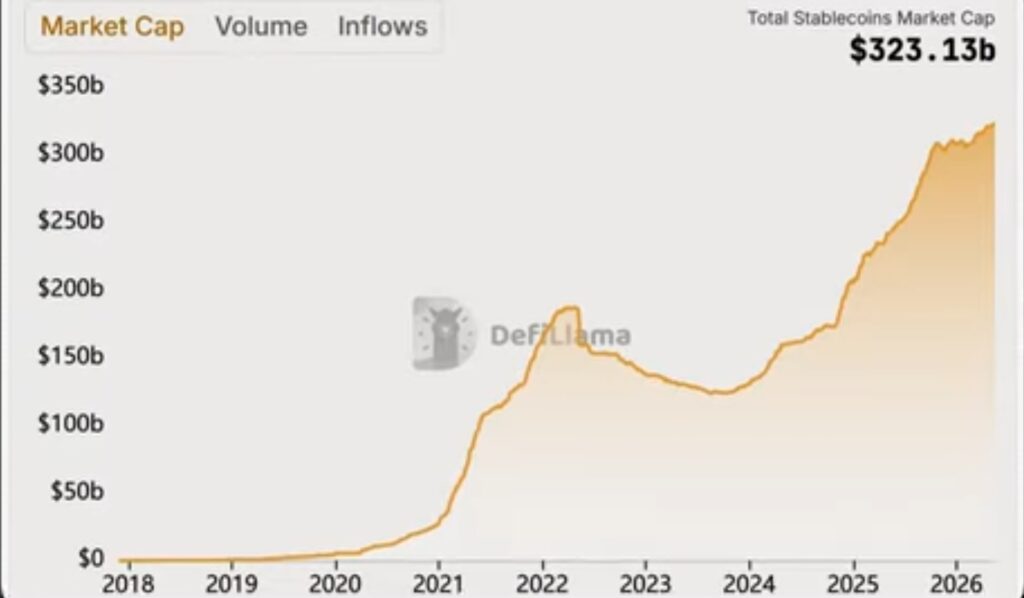
The US is taking the stablecoin route, and trying to make an end run around the faction pushing CBDCs by targeting retail usage directly. Trump has been bragging that they will cement American dominance of global finance. The plan is to maintain the reserve currency status of the US dollar while establishing a permanent market for US debt, given that stablecoins are backed by ownership of US treasuries. The US currently dominates the digital currency market to the tune of 98-99%, and other countries are waking up to the fact that they could be about to lose monetary sovereignty. American stablecoins are a trojan horse for digital dollarisation. If the US succeeds in capturing the global retail market for digital currency, other currencies would become irrelevant. Europe has passed MiCA legislation to regulate stablecoins, which Circle (USDC) has complied with and Tether (USDT) has not.
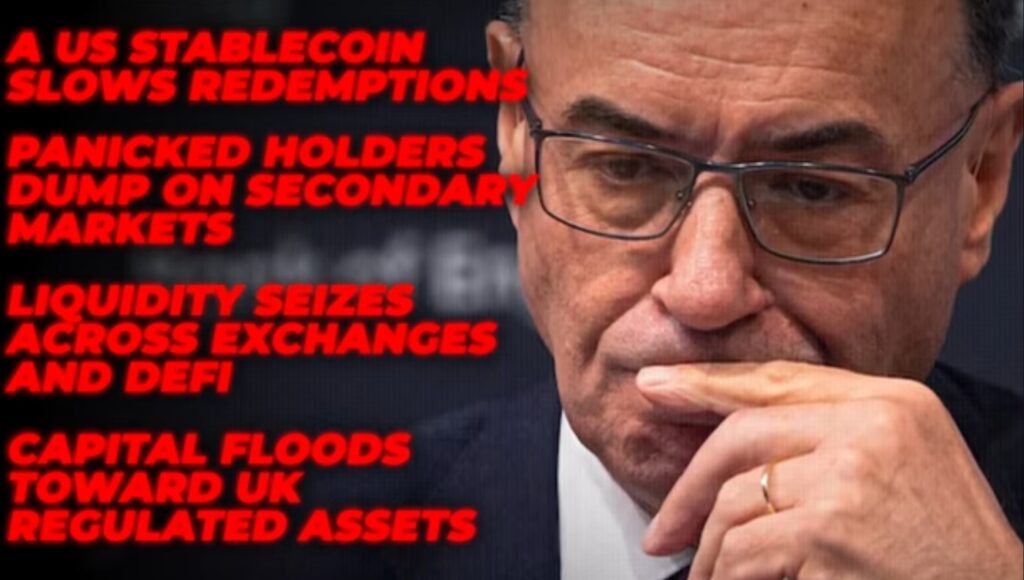
The UK is warning of risks associated with a potential run on a stablecoin. When Silicon Valley Bank failed, there was a brief decoupling of USDC (ie Circle) from the dollar, and there’s a concern that this may happen again. Under the Genius Act, a seven day redemption period is allowed during periods of market stress. In contrast in the UK settlement is on demand, by the end of a business day. Under conditions of stress where holders of American stablecoins would be unable to redeem quickly, they would have to route through an exchange, but if the exchange were also experiencing liqudity problems then there may be a decoupling. Holders may then panic and dump their holdings on to the secondary market. Capital would flood overwhelmingly into better regulated sectors. Weak American regulation of stablecoins creates systemic risk.
The UK seeks to be a crypto hub and remain a world leading financial centre, so it’s developing regulations meant to inspire confidence. They naturally want sterling to lie at the heart of it. If American stablecoins grow in dominance, transactions would bypass SWIFT, sterling, and UK clearing banks. Several other western countries are now developing their own stablecoins backed by their own currencies, but they may be too late to challenge American dominance. Bigger challenges come from China, with the digital yuan, and the cross-border CBDC mBridge system. Countries will be forced to take a side as digital systems compete for users, and geopolitical factions compete for dominance.
Decades ago, at roughly the same time as Nixon took the dollar off the gold standard, ownership of securities was altered, with the effect of depriving investors in financial assets of their direct ownership rights and confering instead a beneficial interest under trust law. The actual legal ownership resides with the Depository Trust Company (DTC), which legally owns $100trillion of securities and keeps track of which investors are associated with which financial assets. DTC is part of the Federal Reserve system, and was initially run by a CIA operative. This is what allowed for the creation of today’s quadrillion dollar derivatives complex, the mortgage backed securities debacle and other financial ‘creativity’, where creativity essentially means fraud. Securities can be used without the knowledge of the beneficial owner. In a crisis, these assets could be confiscated and used to prop up failing financial institutions, and a crisis is coming. Casino capitalism is reaching its maximum extent and a crash is inevitable at some point. Considering the consequences to come from the war in the Gulf, that crash might not be too far off.
Cookie Consent
We use cookies to improve your experience on our site. By using our site, you consent to cookies.
Contains information related to marketing campaigns of the user. These are shared with Google AdWords / Google Ads when the Google Ads and Google Analytics accounts are linked together.
90 days
__utma
ID used to identify users and sessions
2 years after last activity
__utmt
Used to monitor number of Google Analytics server requests
10 minutes
__utmb
Used to distinguish new sessions and visits. This cookie is set when the GA.js javascript library is loaded and there is no existing __utmb cookie. The cookie is updated every time data is sent to the Google Analytics server.
30 minutes after last activity
__utmc
Used only with old Urchin versions of Google Analytics and not with GA.js. Was used to distinguish between new sessions and visits at the end of a session.
End of session (browser)
__utmz
Contains information about the traffic source or campaign that directed user to the website. The cookie is set when the GA.js javascript is loaded and updated when data is sent to the Google Anaytics server
6 months after last activity
__utmv
Contains custom information set by the web developer via the _setCustomVar method in Google Analytics. This cookie is updated every time new data is sent to the Google Analytics server.
2 years after last activity
__utmx
Used to determine whether a user is included in an A / B or Multivariate test.
18 months
_ga
ID used to identify users
2 years
_gali
Used by Google Analytics to determine which links on a page are being clicked
30 seconds
_ga_
ID used to identify users
2 years
_gid
ID used to identify users for 24 hours after last activity
24 hours
_gat
Used to monitor number of Google Analytics server requests when using Google Tag Manager
1 minute
Google reCAPTCHA helps protect websites from spam and abuse by verifying user interactions through challenges.
Name
Description
Duration
_GRECAPTCHA
Google reCAPTCHA sets a necessary cookie (_GRECAPTCHA) when executed for the purpose of providing its risk analysis.
179 days
Marketing cookies are used to follow visitors to websites. The intention is to show ads that are relevant and engaging to the individual user.
A video-sharing platform for users to upload, view, and share videos across various genres and topics.
Registers a unique ID on mobile devices to enable tracking based on geographical GPS location.
1 day
VISITOR_INFO1_LIVE
Tries to estimate the users' bandwidth on pages with integrated YouTube videos. Also used for marketing
179 days
PREF
This cookie stores your preferences and other information, in particular preferred language, how many search results you wish to be shown on your page, and whether or not you wish to have Google’s SafeSearch filter turned on.
10 years from set/ update
YSC
Registers a unique ID to keep statistics of what videos from YouTube the user has seen.
Session
DEVICE_INFO
Used to detect if the visitor has accepted the marketing category in the cookie banner. This cookie is necessary for GDPR-compliance of the website.
179 days
LOGIN_INFO
This cookie is used to play YouTube videos embedded on the website.