Strangling the rise of China is the ultimate goal

The American war plans that are currently being executed go back decades. General Wesley Clarke told us this in 2002 when he revealed that there were plans to attack seven countries in five years, ending with Iran. All the other targets have already been taken out. All were countries not yet vassalised by the Rothschild-controlled financial system and/or had resources that the empire wished to co-opt. Iran is the last man standing on the list, which has taken much longer to execute than originally planned. Iran has both an independent central bank and energy resources, but doesn’t present an easy target at all. In fact it appears that the US/Israeli military machine has grossly under-estimated the scale of the task.

Iran is more united than ever before, and both far better protected and far better armed than had been assumed. Iran is essentially an unconquerable fortress, with military assets protected deep under mountains where they’re safe from all forms of bombing, and the empire’s military machine appears to be stuck in the past, failing to understand the dynamics of the new forms of assymmetrical warfare. Missiles, drones, satellite surveillance, and instant communications are the the new weapons that matter. These lessons should have been obvious from the war in Ukraine, where all of this has been on full display for years, but hubris has evidently prevented those lessons from being learned. The US is now bogged down in a war it cannot win andcan ot seem to extract itself from. Doing so is urgent for them due to the fact that their stocks of air defence interceptors and missiles are running dangerously low, and the empire lacks the surge capacity to produce more in any timeframe that matters.

The war plans have a progression beyond the current target. The ultimate target is China, which has been the empire in the ascendancy for some time, as the American empire enters terminal decline under an avalanche of debt combined with severe military over-extension. A multi-polar world is emerging, and the old empire is doing its best to maintain its former global hegemony. To do this, it must disable the rising power in the east and do so by tackling its allies and support system. Any resources it could potentially claim and use as collateral for its debt burden in the meantime would be a bonus. It’s already failed to balkanise Russia and prevent its energy exports to China, and its clearly failing in Iran as well, which is the critical pivot point for the multipolar world, connecting the land routes required to circumnavigate naval blockades.

Iran has full control over the Strait of Hormuz, and the US has imposed a naval blockade in the Gulf of Oman, out of range of Iranian missiles. It is also bombing land routes, such as railways and pipeline, for export of Iranian oil eastwards. The blockade has managed to reduce exports of Iranian oil by about half, but is unlikely ever to be more successful than this, given the paucity of ships required to police it and the area of ocean that they required to cover. The US is also boarding ships bound for China in the Indian Ocean and the Pacific, which is clearly an act of piracy. It isn’t only Iranian oil blocked from reaching China, but most oil and gas from the whole of West Asia (ie the Middle East).

China has, of course, long since seen this coming and been preparing for it. They have months of strategic reserves, and some alternative sources of supply. They’ve also been electrifying everything in sight as quickly as possible, in order to run on coal and ‘renewables’ instead of oil. The ‘renewables’ (which are not really renewable to to dependence on oil, concrete, and mined minerals) bet won’t work out any better for them than it has for Germany in the long run, due to very low energy returned over energy invested and short lifespan, but may help temporarily. Coal is the workhorse they’re betting on, but unless they can do coal to liquids at scale quickly, they’ll still have a liquid fuels problem if the effects of the war cannot be substantially reversed.

The US appears to be thinking that if it can’t out-compete the Far East, and it can’t, then it will cripple the world economy in order to be the last man standing. If it can’t rise, then everyone else must fall in order for the old empire to maintain relative superiority. The result will likely be billions of casualties in collateral damage, but the empire doesn’t care. It has no regard for human life at all. This is the American version of Israel’s ‘Sampson Option’, which says that if Israel is about to be strategically defeated, it will take the whole world down with it with its nuclear weapons. Russia also has a system like this, called the ‘Dead Hand’, which will fire their arsenal if the central government is taken out. Other powers may also have a similar mindset. This doesn’t bode well for a world caught up in a war cycle, as someone is going to be strategically defeated. The US is imploding and heading for civil war, so it’s the most likely candidate. Its legacy will be one of utter destruction and the beggaring of the world.

Palantir – the emerging global technocracy

Palantir is the face of the developing technical industrial complex (TIC), which is currently challenging both the financial industrial complex (FIC) and the military industrial complex (MIC) for global domination. The technological control they’ve already achieved through the theft and integration of vast amounts of data on billions of individuals is staggering. Now they plan to use that power to gain monopolistic control over the entire population, as Founder Peter Thiel has long sought to do since giving up on the ideas of democracy and freedom years ago.

This power has already been used to deal death on a large scale, using Gaza as the testing ground. Specific individuals were targeted for even the most tangential connections to Hamas. They were monitored until returning home by a programme named “Where’s Daddy”, whereupon their entire apartment complex would be destroyed by a missile strike, killing potentially hundreds of people along with the intended target. It’s patently obvious that human life has no value to those who treat wars as a video game. Palantir has also been used to target undocumented immigrants in the US, allowing them to be seized and used as profit centres for the private prison system. Most of these people have lived their lives peacefully and paid their taxes, despite never being able to claim any benefits, but were targeted, often brutally, in any case. Palantir also bought the NHS health data in the UK and is now in control of that system, very much not to the benefit of the citizenry. It will be used to detect ‘pre-crime’, in other words identifying dissidents, categorizing them as terorrists, and incarcerating them for profit and forced labour. This is the most ruthlessly fascistic system ever developed, and it intends to take control of the entire world. Humans are to be used as non-player characters in a huge video game, where enormous casualties are a feature, not a bug.

Fortunately, the scope of what they ultimately plan will lie outside the range of what future reality can hope to deliver. The energy required to increase, or even maintain, the necessary complexity is very unlikely to exist in a future where so much energy infrastructure all around the world is being deliberately destroyed. The destruction is part of a plan to reduce the global population to a more ‘managable’ size, and to do so quickly, before countries and individuals have a chance to prepare for the engineered crisis. This is exactly what psychopaths could be expected to do in the face of approaching non-negotiable resource limits in energy, fresh water, fertile soil, expansion space, financial engineering/’creative accounting’ fraud etc.

These people are manifestly delusional. They believe that the Epstein class is a different species from the rest of us who are classed as some kind of undifferentiated biomass. They believe they can create their own reality, and through their own ‘brilliance’ they expect to find a way to live forever. Naturally this means they would need to create ‘lebensraum’ (living space) for their own immortal descendents, and to save resources for these hypothetical immortals, the ‘useles eaters’ must be removed. Great wealth leads to great hubris, and major departures from reality, but reality bats last. This attempt at extreme centralisation will ultimately fare no better than previous less ambitious attempts throughout history, but it can be expected to make an enormous mess of the world in the meantime. Communities must urgently come together to support each other through the crisis. We need to outlast their ability to harm us.

This is the manifesto that Palantir just published, followed by insightful commentary from many different writers:

  1. Silicon Valley owes a moral debt to the country that made its rise possible. The engineering elite of Silicon Valley has an affirmative obligation to participate in the defense of the nation.
  2. We must rebel against the tyranny of the apps. Is the iPhone our greatest creative if not crowning achievement as a civilization? The object has changed our lives, but it may also now be limiting and constraining our sense of the possible.
  3. Free email is not enough. The decadence of a culture or civilization, and indeed its ruling class, will be forgiven only if that culture is capable of delivering economic growth and security for the public.
  4. The limits of soft power, of soaring rhetoric alone, have been exposed. The ability of free and democratic societies to prevail requires something more than moral appeal. It requires hard power, and hard power in this century will be built on software.
  5. The question is not whether A.I. weapons will be built; it is who will build them and for what purpose. Our adversaries will not pause to indulge in theatrical debates about the merits of developing technologies with critical military and national security applications. They will proceed.
  6. National service should be a universal duty. We should, as a society, seriously consider moving away from an all-volunteer force and only fight the next war if everyone shares in the risk and the cost.
  7. If a U.S. Marine asks for a better rifle, we should build it; and the same goes for software. We should as a country be capable of continuing a debate about the appropriateness of military action abroad while remaining unflinching in our commitment to those we have asked to step into harm’s way.
  8. Public servants need not be our priests. Any business that compensated its employees in the way that the federal government compensates public servants would struggle to survive.
  9. We should show far more grace towards those who have subjected themselves to public life. The eradication of any space for forgiveness—a jettisoning of any tolerance for the complexities and contradictions of the human psyche—may leave us with a cast of characters at the helm we will grow to regret.
  10. The psychologization of modern politics is leading us astray. Those who look to the political arena to nourish their soul and sense of self, who rely too heavily on their internal life finding expression in people they may never meet, will be left disappointed.
  11. Our society has grown too eager to hasten, and is often gleeful at, the demise of its enemies. The vanquishing of an opponent is a moment to pause, not rejoice.
  12. The atomic age is ending. One age of deterrence, the atomic age, is ending, and a new era of deterrence built on A.I. is set to begin.
  13. No other country in the history of the world has advanced progressive values more than this one. The United States is far from perfect. But it is easy to forget how much more opportunity exists in this country for those who are not hereditary elites than in any other nation on the planet.
  14. American power has made possible an extraordinarily long peace. Too many have forgotten or perhaps take for granted that nearly a century of some version of peace has prevailed in the world without a great power military conflict. At least three generations — billions of people and their children and now grandchildren — have never known a world war.
  15. The postwar neutering of Germany and Japan must be undone. The defanging of Germany was an overcorrection for which Europe is now paying a heavy price. A similar and highly theatrical commitment to Japanese pacifism will, if maintained, also threaten to shift the balance of power in Asia.
  16. We should applaud those who attempt to build where the market has failed to act. The culture almost snickers at Musk’s interest in grand narrative, as if billionaires ought to simply stay in their lane of enriching themselves . . . . Any curiosity or genuine interest in the value of what he has created is essentially dismissed, or perhaps lurks from beneath a thinly veiled scorn.
  17. Silicon Valley must play a role in addressing violent crime. Many politicians across the United States have essentially shrugged when it comes to violent crime, abandoning any serious efforts to address the problem or take on any risk with their constituencies or donors in coming up with solutions and experiments in what should be a desperate bid to save lives.
  18. The ruthless exposure of the private lives of public figures drives far too much talent away from government service. The public arena—and the shallow and petty assaults against those who dare to do something other than enrich themselves—has become so unforgiving that the republic is left with a significant roster of ineffectual, empty vessels whose ambition one would forgive if there were any genuine belief structure lurking within.
  19. The caution in public life that we unwittingly encourage is corrosive. Those who say nothing wrong often say nothing much at all.
  20. The pervasive intolerance of religious belief in certain circles must be resisted. The elite’s intolerance of religious belief is perhaps one of the most telling signs that its political project constitutes a less open intellectual movement than many within it would claim.
  21. Some cultures have produced vital advances; others remain dysfunctional and regressive. All cultures are now equal. Criticism and value judgments are forbidden. Yet this new dogma glosses over the fact that certain cultures and indeed subcultures . . . have produced wonders. Others have proven middling, and worse, regressive and harmful.
  22. We must resist the shallow temptation of a vacant and hollow pluralism. We, in America and more broadly the West, have for the past half century resisted defining national cultures in the name of inclusivity. But inclusion into what?

Excerpts from the #1 New York Times Bestseller The Technological Republic: Hard Power, Soft Belief, and the Future of the West, by Alexander C. Karp & Nicholas W. Zamiska

The following is by Michelle Blair from Collective Evolution on Facebook. No link from facebook is postable unfortunately.

“Palantir recently posted a 22 point manifesto to its social media feed stating “Because we get asked a lot.”

This document deserves to be read carefully as the company is deeply embedded into the US government at the moment, and is making it’s way to other governments. It is one of the most concerning companies on Earth due to what it’s doing.

Let’s look at a couple of points before breaking this down further, I included some of Yanis Varoufakis’ takes on the points as they are spot on:

  1. Silicon Valley owes a moral debt to the country that made its rise possible. The engineering elite of Silicon Valley has an affirmative obligation to participate in the defense of the nation.

Yanis: Silicon Valley owes an immeasurable debt to the ruling class who bailed out the criminal bankers that wrecked the livelihood of the majority of Americans. The engineering elite of Silicon Valley will defend that ruling class to the death (literally!), in the name of the majority of Americans whom they treat with contempt – i.e., like cattle that have lost their market value.

  1. Free email is not enough. The decadence of a culture or civilization, and indeed its ruling class, will be forgiven only if that culture is capable of delivering economic growth and security for the public.

Yanis: Palantir shall give nothing away for free. It cares uniquely over its own growth which it pursues by sowing fear so that it can sell a fake sense of security.

  1. The limits of soft power, of soaring rhetoric alone, have been exposed. The ability of free and democratic societies to prevail requires something more than moral appeal. It requires hard power, and hard power in this century will be built on software.

Yanis: Glory to brute force! Ethics is for suckers. The West needs more of Palantir’s murderous software.

  1. The question is not whether A.I. weapons will be built; it is who will build them and for what purpose. Our adversaries will not pause to indulge in theatrical debates about the merits of developing technologies with critical military and national security applications. They will proceed.

Yanis: AI-powered killer robots are coming. The task is to profit magnificently by building killer robots first and ask questions later. To be able to do so, Palantir will do whatever it takes to avoid at all cost any international treaties that limit AI-driven killer robots.

It goes on. But I want to talk a bit more about Palantir first.

Palantir was founded in 2003 by Peter Thiel, Alex Karp, and three others. Its two primary platforms, Gotham and Foundry, are not simply software products. They are the connective tissue of the modern American surveillance state.

ICE runs on it. The IRS now runs on it. The Pentagon runs on it. The NYPD and LAPD run on it. The Israel Defense Forces run on it while conducting operations in Gaza.

The company is named after the palantiri, the seeing stones in Tolkien’s Lord of the Rings, objects that allow their holders to watch everything, everywhere, all at once.

Interestingly, in the books, every single palantir that survives into the later ages gets corrupted by Sauron. The stones drive their users toward madness and ruin.

The CIA’s venture capital arm, In-Q-Tel, was the only investor willing to fund Palantir in the early days when Silicon Valley passed. Federal contracts grew from 4.4 million dollars in 2009 to 970 million dollars in 2025 under the current administration. The stock surged 200 percent in a single year. CEO Alex Karp was the highest paid executive in America in 2024, with 6.8 billion dollars in reported compensation.

This is not a technology company in any conventional sense. It is a nervous system being grafted onto a government, one that will be very hard to remove later on.

Peter Thiel, Palantir’s chairman and largest shareholder, wrote an essay in 2009 for the Cato Institute. In it he stated plainly that he had come to believe freedom and democracy were no longer compatible with each other.

The man who chairs the company now embedded inside ICE, the IRS, and the Pentagon has publicly wished, in writing, that the Constitution were weaker so that a sufficiently ambitious person could take hold of the country’s direction.

He is not hiding this. He wrote it down and published it.

Thiel is also the primary financial patron of JD Vance, the current Vice President of the United States. He invested roughly 15 million dollars into Vance’s 2022 Senate primary campaign.

Curtis Yarvin is a blogger and self-described neoreactionary thinker. His program, translated out of the elaborate prose he wraps it in, is straightforward. Abolish democracy. Install a CEO-king, run the country like a corporation, let the people who are actually capable of running things get on with it without the friction of public accountability.

At CE, we’d call this a way of running company or country that puts money making and technology first, not human well being. this type of system would likely be void of the sacred, void of deep meaning as it seeks to make things very machinistic.

Peter Thiel invested in Yarvin’s company Tlon in 2013 through his Founders Fund. In private messages that later became public, Yarvin described himself as coaching Thiel and said Thiel was “fully enlightened, just plays it very carefully.”

We have written before about how the ideas that shape our world rarely arrive through official channels. They arrive through the people who fund the thinkers, who fund the politicians, who fund the platforms. The ideology is upstream of the policy. Always.

Yarvinis the ideological permission structure. The intellectual framework that makes what Palantir is building feel not just acceptable but necessary to the people building it. You do not need everyone to believe the idea. You need the people with the resources and the access to believe it.

The Epstein Connection
First, let me mention Point 18 of the manifesto Palantir published: “The ruthless exposure of the private lives of public figures drives far too much talent away from government service.” And now the Epstein connections they wouldn’t want you to know about…

In November 2025, the House Oversight Committee released the Epstein files. The DOJ followed with additional releases in February 2026.

What those documents show is that Peter Thiel corresponded with Jeffrey Epstein from roughly 2014 through early 2019. This continued for eleven years after Epstein’s 2008 conviction as a registered sex offender, and right up until months before Epstein’s 2019 arrest on federal sex trafficking charges.

Epstein referred to Thiel as his “great friend” in private messages to associates.

Epstein invested 40 million dollars in two funds managed through Thiel’s Valar Ventures in 2015 and 2016. That investment has since grown to roughly 170 million dollars. Former Israeli Prime Minister Ehud Barak has described Epstein and Thiel as co-owners of the Valar fund. Thiel’s representatives dispute the word co-owner while confirming Epstein was a limited partner.

Epstein, in recorded conversations, floated Palantir as a company Barak should seek a role at through the Thiel connection.

I want to be direct about why this matters, because it is easy to let it get lost in the noise of everything else.

This is the capital structure of the company now building ICE’s deportation platform. The chairman of a 400 billion dollar surveillance company took transformative money from a convicted sex offender a decade after that conviction, used that person as a relationship broker with former heads of state, and is now embedded at the center of the American government.

The Government Is Now Running On Palantir
ICE signed a 30 million dollar contract with Palantir in April 2025 to build what they are calling ImmigrationOS, an AI platform designed to track self-deportations and feed the mass deportation operation being run by Stephen Miller. Miller reportedly holds a personal financial stake in Palantir.

Palantir employees have been embedded inside the IRS, helping build what Senator Ron Wyden described in a June 2025 letter as a single searchable database of every American’s tax records. Multiple members of DOGE, the entity that selected Palantir for this work, are former Palantir employees.

Trump hired Gregory Barbaccia, Palantir’s former head of intelligence and investigations, as the federal Chief Information Officer.

The Pentagon handed Palantir roughly 10 billion dollars in Army contracts in August 2025. The Navy signed a nearly 1 billion dollar software contract in November 2024.

Palantir’s lobbying spend went from 2.4 million dollars in 2020 to 6.1 million dollars in 2025. They hired Miller Strategies, the lobbying firm most closely associated with the Trump administration.

Again, CE has spoken about the Moloch dynamic, the way systems create incentive structures that reward certain behaviors regardless of the ethics of the people inside them. What we are looking at here is something related but distinct. This is not just a system producing bad incentives; it’s a specific group of people, with a specific ideology, deliberately constructing the infrastructure that will make their vision of the world structurally permanent.

Going back to the 22 points…

Point 6 calls for national service as a universal duty. A draft, in plain language. Working class kids in the field. Palantir employees running the dashboards from Palo Alto.

Point 12 argues that the atomic age is ending and a new era of deterrence built on AI is beginning. Nuclear weapons were governed by international treaties. AI weapons, under this vision, are governed by Palantir’s contracts.

Point 21 states that some cultures have produced vital advances while others remain dysfunctional and regressive.

This is civilizational ranking. Published by a company that has access to every American’s tax records, immigration status, license plate movements, and targeting data. The question of which cultures are deemed regressive, and whose software will act on that determination, is not abstract.

Point 22 calls for resistance to what it describes as “a vacant and hollow pluralism.”

As Yanis translated: According to Palantir, Blacks, Muslims, most Asians, and of course women, are inferior untermensch. Blokes in America, and more broadly the West, have for the past half century resisted putting these subhumans in their places in the name of inclusivity. It was a mistake. Such subhumans must never be allowed in, except as servants or sex service providers – at least until we can improve our robots, in which case we won’t need them at all.

Once again, what we bring up all the time around Breaking The Illusion is important here. The story we have been told about how power works in democratic societies is not an accurate description of how power actually works. It is a story designed to produce a particular kind of citizen. One who believes the system is fundamentally oriented toward their wellbeing, who trusts the institutions, and who therefore does not look too carefully at what is actually being built.

Palantir is what you find when you look carefully, and systems like this have always been there.

The people building this are not operating in a vacuum. They are operating inside a worldview. A specific, coherent, deeply held set of beliefs about what human beings are, what society is for, and what the future should look like.

They feel that most people are not capable of governing themselves. That the people who are capable of running things should be freed from the friction of public accountability to get on with it. That competition is the fundamental law of human existence and that the winners of that competition have earned the right to shape the world. As you might sense, this is not a new worldview, it is a very old one dressed in new language.

And the reason it keeps returning, in different forms across different eras, is that it speaks to something real about how power concentrates when systems are not designed to prevent it. When incentives reward the accumulation of advantage. When the people with the most resources are also the people with the most influence over the rules.

Also, as we’ve always said, removing Thiel or Karp or any individual from the picture does not change the underlying conditions that produced them, nor does it rid the worldview driving their ideas. The conditions are the problem. The worldview is the problem. The incentive structures are the problem. And the fact that the general public is not thinking on a deeper level allows all of this to go on unchallenged as people argue over partisan politics.

Ultimately, what changes all of this is a shift in collective consciousness. A genuine reckoning with the story we have been living inside and a willingness to ask whether it is actually true.

Is ruthless competition really human nature? Is scarcity really the fundamental condition of existence? Is the person with the most resources really the person best suited to make decisions for everyone else?

The evidence, when you look at it honestly, says no to all three. But we have built a world that answers yes. And we have built companies like Palantir to enforce that answer.


By Michelle Blair, CE staff writer.”

The death-throes of empire at a very dangerous junction

The western empire, which has dominated the world for hundreds of years, even before the industrial revolution, is now failing, and its death throes are threatening to take the world down with it. This is the empire’s ‘Sampson option’ – a term usually associated with Israel’s threat to take the world down with them if they appear to be strategically defeated. The empire, a naval power first centred in the UK, and now continued in the US, had long sought to control the heartland of the world in order to prevent the rise of land land power competitor. This was done by controlling client states in sensitive regions around potential rising powers, in order to perpetually raise tensions, create flash points for conflict, and destabilise regions around states of concern. For instance, Israel was envisaged for this purpose decades before the Balfour declaration or the actual creation of the Jewish state through terrorism and destruction. This has worked for centuries, since its inception with Halford Mackinder in 1904, but that strategy is now collapsing.

All wars are bankers’ wars, but the mechanisms for this are poorly understood. Bankers need control over collateral. They need to be the ones to fund projects in order to create assets on their balance sheets that can then be used to leverage further gains through further loans. The clients do the heavy lifting to implement the project, but the bankers always profit, in return for creating currency from thin air, and if the project fails to pay the interest on the loans, they claim the assets as well. They require the ability to use force, but don’t possess this themselves, so they must co-opt powers that do possess this capacity. As such, empires do not belong to the countries they inhabit, they merely use them to perform functions that the bankers cannot perform by themselves. The result is the concentration of wealth in the hands of bankers and their associated elites in specific geographical locations, in this case the West. Host countries are parasitised by empire, and their populations extracted from and exploited in order to amass wealth for the banking cartels which currently rule the world. Host elites benefit from empire directly, and populations might temporarily (just long enough to be lulled into a false sense of superiority and security), but the long term impact on imperial populations is invariably negative.

The current iteration of empire is failing. The debt level has become unsustainable, the ability to successfully project power at a distance is increasingly being seen grossly exaggerated, and fewer vassals states are prepared to both pay for empire and comply with its dictats. There have already been significant failures of imperial strategy envisaged to prevent this decline. The engineered pandemic was intended to lead to the impositon of a comprehensive control grid, but people woke up too early and prevented it from taking hold. The attempt to frighten people with a ‘climate emergency’ supposedly requiring strict control measures has also failed. The empire thought it could use Ukraine as a battering ram against Russia in order to rapidly force it to balkanise into controllable portions, but the result has been a newly self-sufficient Russia that is far more powerful than before the war, and which has already defeated the collective West. Russian and Ukrainian resources will not now become Western bankers’ collateral. Now the Iran project is failing, due to gross under-estimation of Iran’s ability to prepare for conflict, and not only resist it, but to gain considerable leverage against the empire in the process. Now the empire is trying to gain naval control of global choke points for trade, but it lacks the naval assets and firepower to be able to achieve this more than at most temporarily.

The American military industrial complex builds weapons for profit, not for winning wars. It’s weaponry is over-complicated, far too fragile, far too expensive, and lacks manufacturing surge capacity. Trump’s attempts to have industrial outfits such as car manufacturers convert their facilities to weapons production are far too little and far too late. In the few weeks of the war with Iran, the US has already used up some 50% of its interceptors and missiles. It cannot rearm and cannot sustain the conflict, unlike Iran, which has been planning for a long war of attrition for decades. The US cannot tolerate casualties, while Iranian culture is grounded in a narrative of martyrdom as a direct route to heaven. Young people gather in the streets around potnetial targets, ignoring the likelihood of being bombed. This would never happen in the individualistic West. Cultural solidarity is a powerful weapon in itself, and Iran has undoubted escalatory dominance.

Trump considers using nuclear weapons and is told no

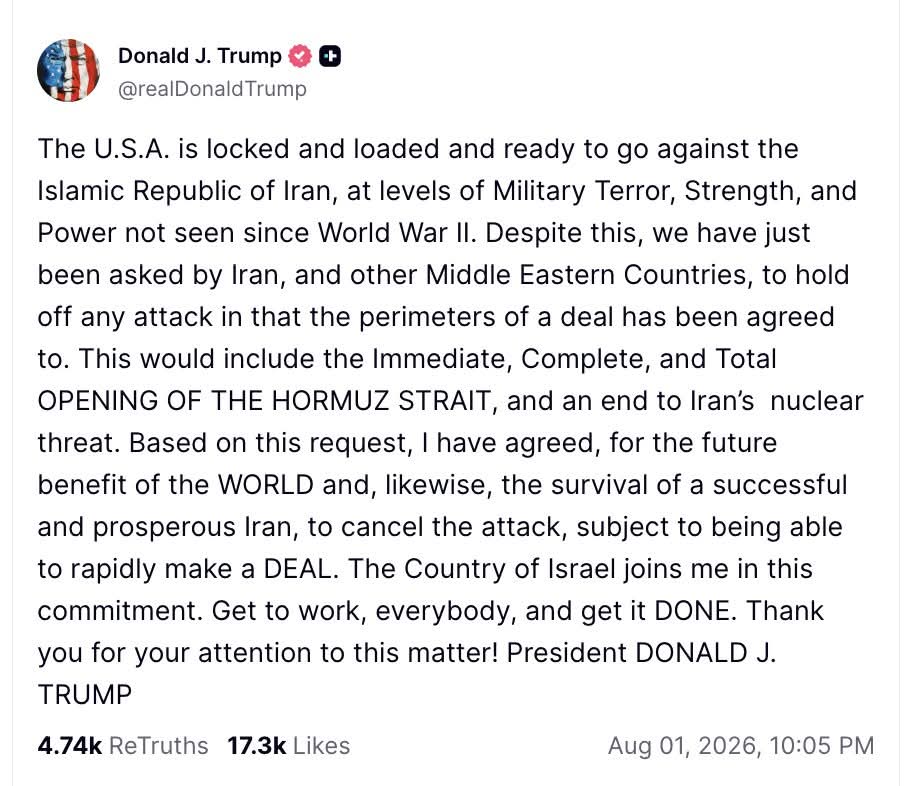
According to several different military analysts, Trump was recently discussing the nuclear launch codes with the Chairman of the Joint Chiefs, General Dan Caine. Apparently there was a heated discussion, and General Caine told him no. The situation by no means warrants action that extreme. The ceasefire will be ending very soon, and Trump wants to escalate in order to, in his mind, finish Iran off and extracate himself from the region. He’s already bored with the war, and he knows how desperately unpopular it’s making him. The usual American tactic of simply declaring victory and leaving would not work, as the loss and the humiliation of it would be too obvious. Trump’s dangerously unhinged rhetoric has painted the himself into a corner. The US cannot win this war, but neither can it admit that it lost. Trump’s narcissism guarantees that he can never acknowledge defeat. Even if a deal were reached between the US and Iran, Israel would destroy it in order to ensure the continuation of the war, since their goal is the utter destruction of Iran.

Short squeeze when the paper market meets the physical market

There is a substantial difference between the oil price in the paper market and that of physical oil for delivery. The paper market is being manipulated to manage the price and keep markets calm, hence the scale of the coming energy emergency is not being accurately reflected. In other words, the market is not pricing in the actual degree of risk. In contrast, the physical market, where prices are substantially higher, is exhibiting a form of panic as the supply shock looms. Asia is now receiving only 6% of its normal amount, and both Australia and New Zealand are down stream from Singapore, Malaysia, South Korea and Taiwan, where their supplies of finished fuels come from. None of these locations have much in the way of reserves of their own, and so will not be sending supplies further along the supply chain. Australia has already received its last shipment. South Korea has already declared a state of emergency and is warning of an end to modern life.

At some point in the not too distant future, the paper and physical markets will be forced into convergence. Bets placed in the options market that the price would fall, due to misplaced optimism around peace talks or far too much faith in Trump’s manipulative pronouncements, are going to be forced to buy when the option runs out, and they will have to buy at the spot price. This is short squeeze, and it will be very painful. At that point a price surge is extremely likely. The US will likely be the last to feel the effects, but not by much, as the crunch will be global.

Bond markets show that risk is rising, with the exception of China, which is now being perceived as a haven of relative safety. China has substantial oil reserves and is much less vulnerable than most of the rest of Asia. However, the US is acting to cut off China’s supply in as many ways as it can, with export blockades from suppliers to attempting to gain control over vital shipping choke points. The Strait of Malacca is the most critical, and the US is seeking control over it through deals with Malaysia and Indonesia. US Treasury Secretary Scott Bessent has explicitly said that China is the target. China may now begin to provide its ships with a military escort as a result, daring the US to act against them. China has critical leverage over the US due to its control over rare earth elements necessary for American military production.

The US appears to be moving towards using their navy to enforce a global protection racket, extorting the rest of the world in a form of piracy. It’s doubtful whether this would be at all possible though, since the US does not have military superiority compared to the rest of the world combined. In fact the perception of US military prowess has been signifcantly dented due to its failures in West Asia (ie the Middle East). First they failed to deter Ansar Allah (ie the Houthis) from controlling passage through the Red Sea. The declared victory and left, but the actual result was obvious. Now they’ve failed to defeat Iran and are failing to fully contain shipping in the Gulf of Oman. The ships cannot approach the coast of Iran or they will come within firing range. The tentative ceasefire is almost over, so their ships will have to retreat further and be even less effective. The psychological warfare of issuing threats will only go so far if not backed up by actions.

To add insult to injury in the energy markets, a whole series of refinery explosions have occurred in recent weeks all across the world, on top of the destruction of Russian infrastructure by Ukraine (as a proxy for NATO). This cannot be a coincidence. Some entity is attempting to force the world off fossil fuels, in line with Agenda 2030. Given the scale of the damage, repairs, if possible at all, would take months to years, so a global supply shock more severe than all previous oil shocks combined is guaranteed.

Energy crisis by the numbers

Chris Martenson is an excellent, data-driven energy analyst. Energy is the ability to do work, hence energy and GDP are extremely tightly connected. The coming energy crisis will be the worst in human history, as never before have we had so far to fall in such a short time. The pace of change will be exceptionally difficult to adjust to. Oil is the lifeblood of the economy. Prior to the war we produced about 86 million barrels/day, but now we’re down by 10million barrels/day. Over the 48 days of the war, the world is missing 480 million barrels of oil, which cannot be made up later. The world last produced 76 million barrels/day in 2011, when the global economy was 36% smaller than it is today. GDP will be forced back to that level in a rapid supply shock, and the longer the war and disruption go on, the worse the situation will get. As the war is unlikely to be over soon, and disruption would continue for years afterwards, a global economic depression, with massive demand destruction, is now guaranteed.

So far pending deliveries have been made and reserves are being drawn down, so the crisis has yet to hit, but it won’t be long. Countries with little in the way of reserves, or reliant on long supply chains will be particularly vulnerable. Producing and exporting countries are likely to cease exporting in order to keep their reserves for themselves, further reducing supplies available to others. Refining capacity will be important, in order to produce specific fuels and feedstocks. The lack of it will be a very significant problems, as cargos of finished fuels will be in high demand and will go to the highest bidder. In a very few weeks, prices are going to spike considerably, and availability is going to be a major problem. Supply chains for many products are going to be substantially disrupted, perhaps permanently. Once a scarcity mindset kicks in, fuel hoarding will be rampant, for those countries and consumers able to afford it.

Besides the war itself, a significant amount of energy infrastructure around the world has recently been destroyed, particularly in Russia and Ukraine, but also refineries and gas storage in places like America, Mexico, and Australia. In addition, fertiliser plants have been exploding, and fertiliser is also in acute shortage due to the war and its blockage of transport. The scale of the destruction and the timeframe suggest that these were not all accidents. As Chris Martenson says, “once is an accident, twice is a coincidence, but three times isene y sction”. It seems that the global elites have decided not to waste a good poly-crisis, but to accelerate it in order to push their agenda of depopulation and control. Demand destruction, immobilisation, and control over the food supply are foundational apects of Agenda 2030.

A wide range of hydrocarbons are now referred to as petroleum, but the longer chain hydrocarbons are the really neccessary ones for the global economy. Short chain hydrocarbons are not oil and cannot be used to produce the diesel, kerosene and bunker fuel that keep the world moving. Without these products, industry, agriculture, shipping, air travel, and distribution throughout the economy would grind to a halt. The US is fond of bragging about its energy reserves, but it produces mainly short chain hydrocarbons, which it exports, and must import heavier grades. This is the primary reason for its invasion of Venezuela, although it will take a long time to bring in the very heavy grade Venezuelan oil in a meaningful quantity. Oil from Iran and Iraq is perfect for US refineries. The US remains a net energy importer, exporting about 4million barrels/day and importing 6million.

Refineries are designed for specific grades of crude, and cannot easily be retooled to operate on different inputs. The outputs they’re designed to produce are spoken for in many different and complex supply chains, so any retooling of a refinery would disrupt countless aspects of the economy. The supply chains are too complex to be adequately modelled, so specific results and knock-on effects are impossible to predict accurately.

Because the war has caused a virtual ceasation of transits through the Strait of Hormuz, production was backing up in the Persian Gulf. Once storage was full, production was shut in, but this is problematic, because once the fluid injections guiding the oil towards outlets have ceased, the oil spreads out again within the field, and may not be able to be concentrated in the right area. In other words, production shut ins damage the field, and if restarted, production would be at a permanently lower level. Production of some 8-9million barrels/day have been shut in in the Gulf countries.

The US currently seems fixated only on their stock market, which is no indicator of the health of the real economy, and is currently elevated artificially by the bubble in AI stocks, which resemble a circular firing squad of financial engineering. The American regime is constantly manipulating the market and raising expectations skyhigh by spinning economic narratives that bear no resemblance to reality, and when reality asserts itself, it will come as a tremendous shock. Collective dashed expectations are extremely dangerous, especially in a highly polarised country with more guns than people. The regime is currently trying to control the flow of global trade into the future by attempting to control all the major maritime choke points, primarily with a view to halting the rise of Asia in general and China in particular. A deal being negotiated with Malaysia and Indonesia could confer control of the Strait of Malacca, which is the most critical in the world.

This oil shock will be larger than all previous ones combined, and it will happen at the same time as 20% of LNG is offline, fertiliser is missing for planting season, as well as sulphur for extraction, helium for computer chip manufacture, and many other critical inputs for the global economy. The real crisis has not yet begun, but it will start soon. Far too many people are energy-blind, and sleepwalking into disaster completely unprepared. Awareness must be raised, and communities must band together for mutual aid.

The takedown of Australia and New Zealand and the coming famine

As if the pointless and unjustified war of aggression by the rogue hegemon and its Israeli master were not doing enough to take down much of Asia and Oceania, now industrial ‘accidents’ across multiple fronts are destroying the remaining capacity for Australia to cope. For this to happen actually by accident is not credible. The odds against it are astronomical. Australia has only two refineries, and one of them just exploded. The country was already 90% dependent on imports that will no longer be arriving, and now that dependency is even worse. (It should be pointed out that there has been a string of recent and unexplained refinery fires in various countries around the world, and likely none are accidents.) At the same time, the major fertiliser plant experienced a fire that’s taken it offline for at least two months at the worst possible time – planting season. Two major gas terminals have also been knocked out, and grocery prices are set to rise 20% very quickly.

Global energy and fertiliser suppliers are halting exports in order to conserve for their own use, understandably. Planting season for winter crops is a short window, and that window will be missed. Some farmers are planting less fertiliser-dependent crops, while others aren’t planting at all. Farmers who are planting don’t know if they’ll be able to harvest due to diesel shortages, and even if they can, it may not be possible to distribute the food. The entire supply chain is being squeezed from every side. Fresh food requiring refrigeration is likely to disappear first. Dependency is vulnerability, and this part of the world is acutely dependent on critical imports that will no longer be coming.

To call this an epic disaster would be an understatement, and the crisis has barely begun. Australia is about to move to phase three of their emergency plan, with fuel rationing, allocations to specific sectors (emergency services, utilities, freight, agriculture, food supply chains), and mandated demand reduction from the civilian sector. Of course this is necessary under the circumstances, but those circumstances were not naturally occurring. Stage four is coming, but not immediately. That will see all infrastructure close down, food chains collapse, a driving ban, and rationing of everything. New Zealand, with no refinery at all, and even further down the fuel supply chain, will not be far behind.

Does anyone else think all of this sounds exactly like what Agenda 2030 was trying to achieve? They were behind schedule, since the toxic shot death toll was insufficient (so far), and too many people had stopped believing in the fake climate emergency, so they seem to have decided to force the issue. The primary target is the western middle class. Europe is already toast, since their primary energy supply through the Nordstream pipline was already cut off by the US, and now the southern route is blocked by war. Canada is self-immolating and likely to break up, the US is imploding into christo-fascism under a warmongering ‘mad king’, and Australia and New Zealand are to be starved. All of this is their population reduction strategy, and they want it to happen quickly, so there are fewer mouths to feed and fewer survivors to have to control through their planned digital gulag. To call these Epstein-class people who are orchestrating this evil is a considerable understatement. They plan to genocide billions of people.

Communities absolutely have to come together to help each other survive. We have no choice.

The UK tells its people to prepare for war, higher taxes, and energy lockdowns

This is ridiculous. Russia is no invasion threat to the UK, or anywhere else in Western Europe. The only potential threat would be from missiles targeting weapons production sites in retaliation for Europe arming Ukraine in order for them to attack deep into Russian territory. Russia lacks the capacity even if they wanted to take European territory, which they don’t. They don’t even want western Ukraine, which, unlike eastern Ukraine, is actually full of hostile Ukrainians, and no one in their right mind wants to rule over a permanent insurrgency. Western Ukraine is full of Russians who’ve been abused by the government in Kiev for many years, and shelled since the US-backed coup in 2014, costing some 14,000 lives. Russia stepped in to protect them when it became clear that the Ukrainian army was headed east to eliminate them. Now that Russia has spent blood and treasure to save them, it won’t be giving up the five oblasts it’s claimed (Crimea, Lugansk, Donetsk, Zaporizha, and Kherson), backed by popular referenda in each one. Four more oblasts (Kharkiv, Nikolaev, Odessa, and Dnipro) may be added to the list if Ukraine continues its NATO-funded-and-supplied war. None of this affects western Europe directly, only impoverishes it, due to the billions sent to Ukraine rather than spent on their own people, and disarms it, due to the mountain of old equipment sent.

several European countries are now foolishly and unnecessarily talking about conscription, with the UK seemingly at the front of the pack. The media is now chiming in to support this:

The UK is doing this while raising taxes on the people, many of whom are desperately stuggling to make ends meet, in order to send yet more money to the financial blackhole of Ukraine. This money will then promptly be stolen by the Ukrainian kleptocrats, in what is one of the most corrupt countries in the world.

At the same time, Britain wants to remilitarise, and will need to tax and squeeze its poor citizens even more. Remilitarisation to any reasonable standard isn’t even possible, no matter how much can be extracted from the population, and the UK has no experience of modern drone warfare in any case. Soliders sent into combat with obsolete tactics and equipment will simply be slaughtered. One only has to watch the Ukrainian and Iranian wars to see how much warfare has changed. As Neil McCoy-Ward points out in the headline video, Rome taxed its farmers 90%, and then watched them abandon the empire. Many Britons are doing the same, with a major exodus of both young people and the wealthy, who have the option to avoid being squeezed.

Energy lockdowns are also coming, even though Britain gets most of its energy from Norway, not from the Persian Gulf. Neil discusses the existing legal framework allowing for it to happen, some going back to the oil shock era of the 1970s. The Energy Policy and Conservation Act of 1975 provides for legal energy lockdowns. The Energy Act of 1976, updated in 2000 when the UK saw fuel riots, provides for control over the fuel supply by creating a framework for deciding who can have fuel, for restricting usage, for setting up an allocation system to prioritise different sectors. There is also a Petroleum Act of 1998.

The UK was obviously aware that energy security might be an issue, yet did not establish reserves. Instead, after the discovery of North Sea oil and gas, it threw caution to the wind and exploited those reserves at the highest production to reserve ratio of any oil producing region. Those reserves, plus the City of London financial ponzi scheme, are the reasons the UK did not collapse, and indeed boomed, when it lost its empire. Both of these factors are now about to go into reverse, as North Sea oil and gas in the UK sector peaked years ago, and the end of the major debt cycle is rapidly approaching, which will be fatal for the ponzi scheme. UK citizens have no idea what’s about to hit them. Few seem to remember the late 1970s, when a desperate Britain went cap in hand to the IMF and a three day work week was introduced. Few remember the coal miners strike of the 1980s, which almost brought down the power grid. The Great Depression is the 1930s has almost entirely passed out of living memory. What’s coming will be a terrible combination of all of those factors. The UK is headed directly towards a world of hurt.

The attempted American blockade and failed fake peace talks

The attempted American blockade suffers from a number of difficulties. Ships cannot get close to the Iran, because their anti-ship missiles have a substantial range. Carriers too close would be sitting ducks. There would be no need to sink them, just to destroy the flight decks in order to render them useless. In order to stay out of range, the blockade must cover a much greater distance, but the US does not have the military hardware to control long distances at sea. There is no armada, and no fleet of helicopters, speedboats and drones, which would be necessary for visual inspection and boarding. Military control is very unlikely to succeed, but confusion and fear of risk amongst shippers is likely to reduce the number of ships passing. China will likely defy the US successfully, but ships from smaller nations with less leverage may not. Iran can export oil by other means, so its export capacity would be reduced but not curtailed completely. The US is also bombing the Chinese-built railroad running through Iran and beyond for this reason. So much for the excuse that the war was about liberating the Iranian people. It’s clearly an attempt to destroy the country completely, in accordance with Israeli wishes, and to halt the rise of Asia in general, and China in particular, by cutting off their energy supply.

Another goal is to prevent the Taiwanese chip company TSMC from being able to manufacture their advanced chips at home, due to shortages of both LNG for fuel and helium, which necessary for chip making. The US is trying to pressure TSMC to relocate to Arizona, so it can control advanced chip manufacture. TSMC has tried to build a facility there, but has suffered many setbacks, and cannot find an appropriate workforce. While the US is busy trying to blockade the Straits of Hormuz externally, China and the Taiwanese opposition party, which favours reunification with the mainland, are holding talks. China may reunify with Taiwan and gain control over the chip fabs before the US can do anything about it. The US has threatened to bomb the fabs if this were to happen, but this doesn’t exactly please the Taiwanese. Bullying and brute force do not win friends, or keep friends. The US is merely demonstrating that it’s a gangster regime.

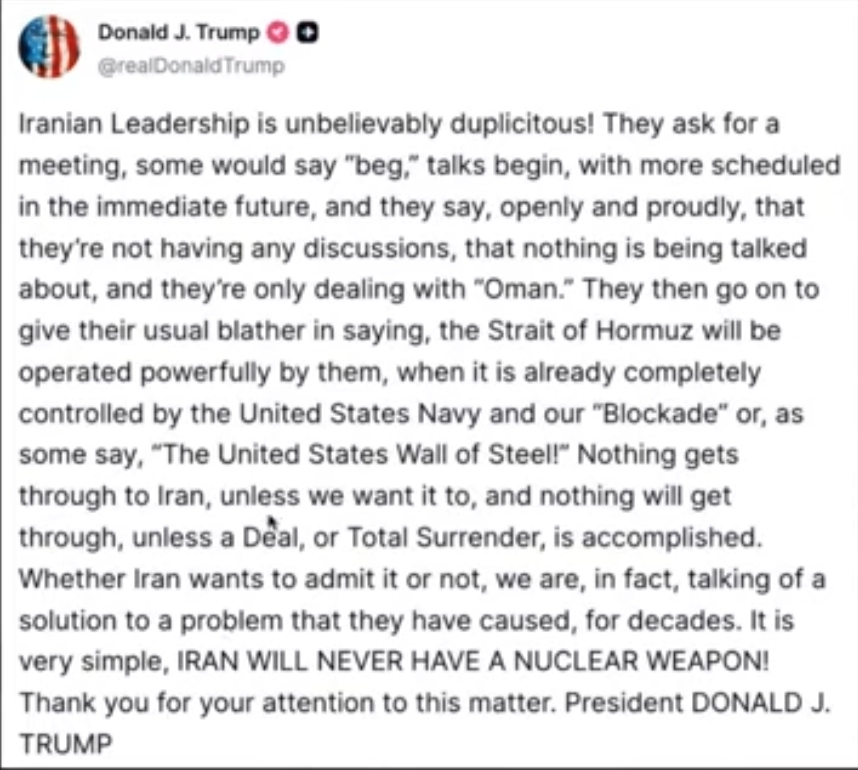
The so-called peace talks in Islamabad were never intended to be successful. They were about buying time for Trump to find a way out of the quagmire he finds himself in. Unfortunately for him, there is no way out but a humiliating withdrawal, because Iran can withstand a long war of attrition while the US cannot. Iran sent a highly qualified and well-informed team to Islamabad, while the US sent unqualified and ill-informed zionist lackeys and grifters, Kushner and Witkoff, along with JD Vance, who also has no relevant knowledge or experience. The negotiating position of the Iranians was reasonable, but that of the Us/Israeli side was not. They were insisting that Iran abandon its missile defence system, hand over all of their enriched uranium, and agree to share revenue from the Hormuz tollboth system (revenue that would then go to the Trump family and friends). In other words, the US was demanding complete capitulation as a final offer, which was never going to be remotely acceptable. The American team had no authority to agree to anything independently, and were constantly phoning both Trump and Netanyahu for approval. The on the last call with Netanyahu, they were instructed to shut down the talks and walk away. The intransigence was entirely on the US/Israeli side, because while Trump may want a deal, Netanyahu does not. Israel wants nothing less than the complete destruction of Iran.

Trump is already bored of a conflict dragging on far longer than the Israelis has convinced him it would when they talked him into it (no doubt under threat of revealing the kompromat they have on him). He wants nothing more than to declare (false) victory and leave. His regime is composed sycophants, vassals, cronies, manipulative fake pastors (eg Paula White) and technofeudalists waiting to take over when he’s eventually pushed aside, possibly under the 25th amendment. (His recent portrayal of himself as Jesus and fight with the Pope have likely hastened that day.) Vance is a creation of Peter Thiel, whose goal is a global panopticon, with full spectrum surveillance and control of humanity. His ascendancy to the presidency would be a different kind of nightmare.

Trump cares only about the political consequences for himself, and not at all about the looming global catastrophy that his unprovoked war of aggression is causing. His narcissism is all-consuming, and compounded by senility and sadism. The imploding US empire faces strategic defeat and reduction to a regional power, while much of the rest of the world faces immediate energy crisis and famine within months. If this continues for much longer, the global economy will collapse, and the entire planet will blame Trump.

This interview expands on the scale of the consequences of the blockade. Energy, GDP, and population are extremely tightly linked, and global energy supply has already taken a huge hit. This will affect countries differently, depending on local circumstances. Those with sovereignty and self-sufficiency (for instance Russia and Iran) can maintain a viable state. For many less fortunate others it will mean complete collapse into anarchy, with mass death. Structural dependencies are vulnerabilities, and can be catastrophic when input conditions change for the worse.

Many consequences, including a global recession, are already inevitable, and if the war lasts longer than another month, a global depression worse than the 1930s will be guaranteed. When the Suez canal was blocked some time ago, every day of blockage required six days to restore, if that same measure were applied to the blockage of Hormuz, recovery would take until early 2027 if the war stopped tomorrow, and for a 16 week closure it would take until late 2028. These estimates likely understate the case significantly, since the war may go on for much longer, and a great deal of essential infrastructure has been damaged or destroyed. This will take months to years to restore, assuming the conditions for restoring it still exist. Supply chains are to complicated to model accurately, and have little to no resilience under a just-in-time paradigm. Once they fracture, restoring them may not be possible, especially in a low energy and low trust environment.

The WEF globalists will of course use the crisis to force through many of their pet ideas. Among their stated goals are the end of air travel, shipping, and global trade, while constraining human freedom through limited and tightly controlled purchasing power, and forcing people to accept both a nutritionally deficient diet and forced ‘medications’, and population reduction. They may achieve all of that, unless chaos increases to a level where control by anyone becomes impossible, which would derail some of their coercive ideas. Interestingly, Netanyahu has connections with the Davos crowd and the WEF. Perhaps he’s helping them fulfill their goals.

Verified by MonsterInsights